VA PUGET SOUND/UNIVERSITY OF WASHINGTON Seattle, WA, United States
Disclosure(s): No financial relationships with ineligible companies to disclose
K Wysham1, Hannah Brubeck2, Aaron Baraff3, Punyasha Roul4, Namrata Singh5, James Andrews6, Grant Cannon7, Gary Kunkel8, Ted R Mikuls9, Bryant England4, Dolores Shoback10, Patti Katz11, Jose Garcia12, Ariela Orkaby13 and Joshua Baker14, 1VA Puget Sound/University of Washington, Seattle, WA, 2VA Puget Sound Health Care System, Seattle, WA, 3VA Puget Sound Seattle, Seattle, WA, 4University of Nebraska Medical Center, Omaha, NE, 5University of Washington, Bellevue, WA, 6University of Washington, Seattle, WA, 7University of Utah and Salt Lake City VA, Salt Lake City, UT, 8University of Utah, Salt Lake City, UT, 9Division of Rheumatology and Immunology, University of Nebraska Medical Center, Omaha, NE, 10San Francisco VA Medical Center, San Francisco, CA, 11University of California San Francisco, San Rafael, CA, 12VA Puget Sound Healthcare System, Seattle, WA, 13Veterans Affairs Boston Healthcare System & Brigham and Women’s Hospital, Harvard Medical School, Boston, MA; VA Geriatric Research Education and Clinical Center, Boston, MA, 14University of Pennsylvania, Philadelphia, PA
Background/Purpose: Frailty occurs prematurely in RA. Levels of frailty are higher in Veteran populations than civilians1. Frailty has been shown to predict osteoporotic fractures in a single Canadian RA cohort, however the frailty instrument lacked external validation2. The aim of this study was to evaluate whether frailty predicted incident osteoporotic fractures in Veterans with RA using an externally validated frailty index.
Methods: We used data from the national Veterans Affairs Rheumatoid Arthritis (VARA) Registry 1/2003-12/31/2021. Baseline frailty was calculated using the VA Frailty Index (VAFI)1. The VAFI is based on diagnostic and CPT codes which are categorized into 31 deficits including morbidity, function, mood, cognition and geriatric syndromes. Osteoporotic fractures were identified by searching fracture-related diagnostic and procedure codes and subsequently validated by chart review. High-trauma, periprosthetic and pathologic fractures related to cancer were excluded. Missing data at baseline were imputed using multiple imputation with chained equations with 10 iterations and for further time points using the last observation carried forward. Age-adjusted fracture incidence rates were calculated. Multivariable Cox regression evaluating the relationship between baseline frailty and incident osteoporotic fracture was performed adjusting for baseline age, sex, race, smoking status, anti-cyclic citrullinated peptide (CCP) positivity and prior osteoporotic fracture; and time-varying body mass index (BMI), DAS28ESR, prednisone use, conventional synthetic disease modifying antirheumatic drug (DMARD) use, and biologic DMARD use. Participants were followed from enrollment and censored at osteoporotic fracture, death or end of study period.
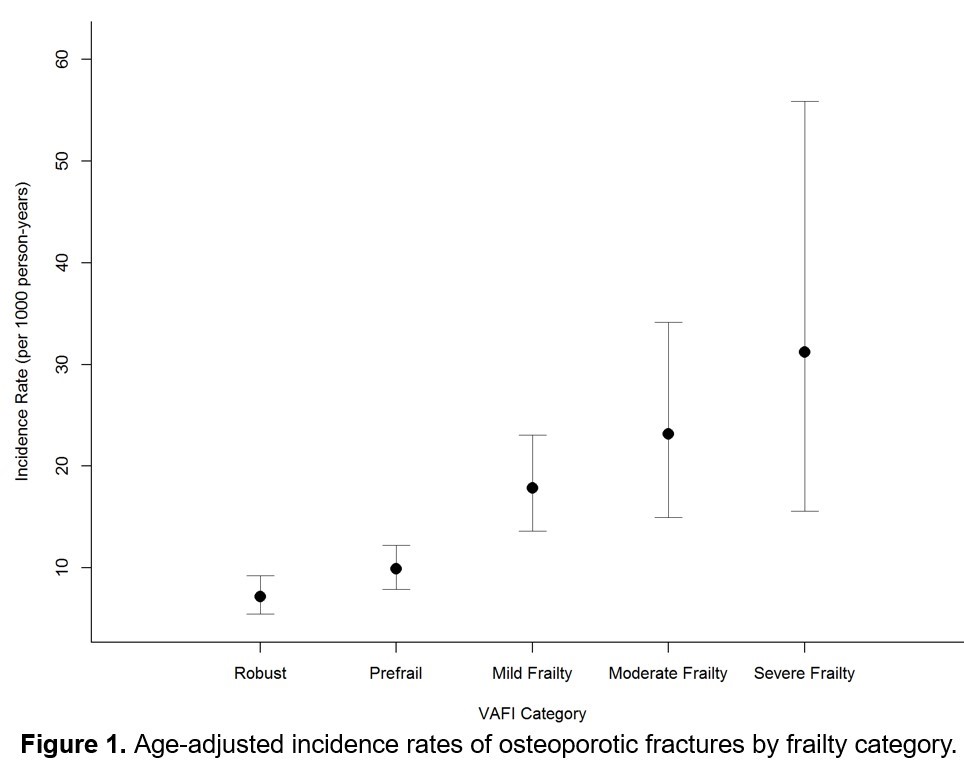
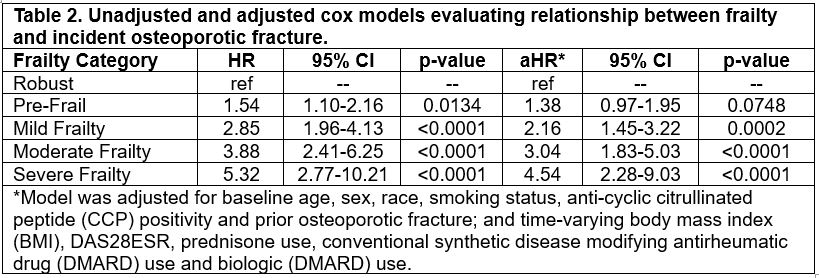
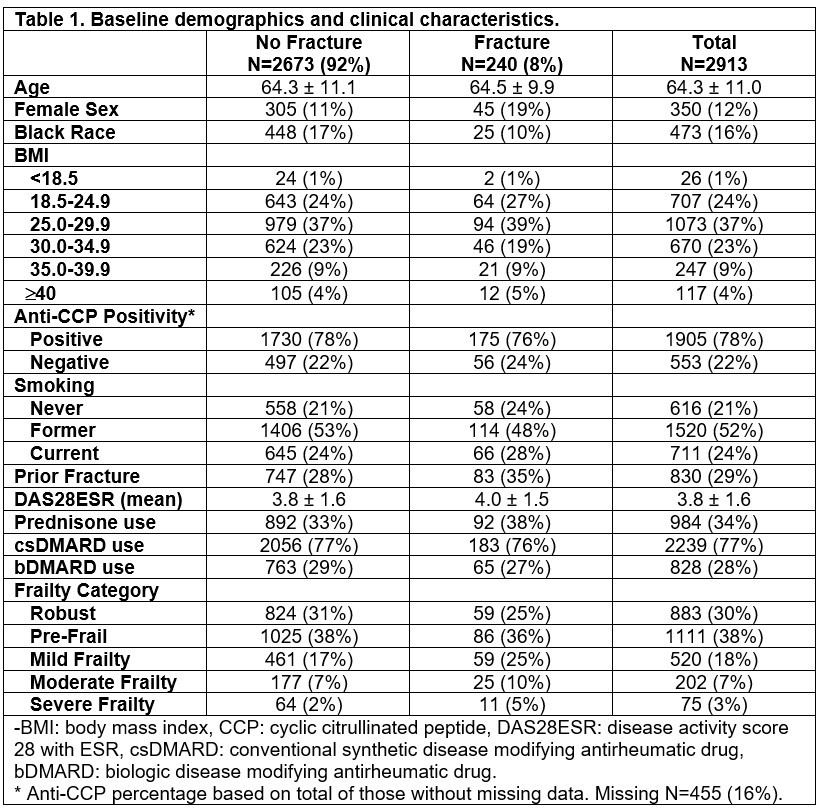
Results: 2,930 Veterans were included, mean age 64±11 years. Compared to those without incident osteoporotic fracture, those with fracture were more frequently female (19% vs 11%), less frequently Black (10% vs 17%) and had more pre-enrollment fractures (35% vs 28%) (Table 1). Age, anti-cyclic citrullinated peptide (CCP) positivity, BMI, disease activity and medication use at baseline were similar between those who did and did not fracture. There were higher rates of baseline frailty in the fracture group (25% vs 17% mild frailty, 10% vs 7% moderate frailty, and 5% vs 2% severe frailty). Over the 21,800 person-years of observation, 240 incident osteoporotic fractures occurred (79 extremity, 58 rib, 47 spine, 43 hip and 13 pelvis). Age-adjusted incidence rates of osteoporotic fractures increased by frailty category (Figure 1). In the multivariable Cox model, mild, moderate and severe frailty each had significantly increased risk of incident osteoporotic fracture compared to those who were robust (Table 2; aHR 2.16 [95% CI 1.45-3.22], 3.04 [95%CI 1.83-5.03] and 4.54 [95%CI 2.28-9.03]; all p< 0.001, respectively).
Conclusion: Baseline frailty is associated with incident osteoporotic fractures in Veterans with RA. Frailty measurement in RA using the VAFI, a validated, automated tool, may prove to be useful in identifying Veterans at high risk for osteoporosis and fractures. 1Orkaby AR et al. J Gerontol A Biol Sci Med Sci. 2019 2 Li G et al. Bone. 2019
K. Wysham: None; H. Brubeck: None; A. Baraff: None; P. Roul: None; N. Singh: None; J. Andrews: None; G. Cannon: None; G. Kunkel: None; T. Mikuls: Elsevier, 9, Horizon Therapeutics, 2, 5, Pfizer, 2, Sanofi, 2, UCB Pharma, 2, Wolters Kluwer Health (UpToDate), 9; B. England: Boehringer-Ingelheim, 2, 5; D. Shoback: None; P. Katz: None; J. Garcia: None; A. Orkaby: Anthos therapeutics, 2; J. Baker: Bristol-Myers Squibb(BMS), 2, Burns-White, LLC, 2, CorEvitas, LLC, 2, Pfizer, 2.