First faculty of medicine and Institute of Rheumatology, Charles University Prague, Czech Republic
Disclosure information not submitted.
Aneta Pekacova1, Jiri Baloun2, Adela Navratilova3, Lucia Ondrejcakova4, Jana Zborovjanova4, Petr Fulin5, Rastislav Ballay6, Michal Tomcik7 and Ladislav Senolt8, 1First faculty of medicine, Charles University, Prague, Czech Republic, 2Institute of Rheumatology, Prague, Czech Republic, 3Institute of Rheumatology and Department of Rheumatology, First Faculty of Medicine, Charles University, Hlavní město Praha, Czech Republic, 4Institute of Rheumatology and Department of Rheumatology, First Faculty of Medicine, Charles University, Prague, Czech Republic, 5First Department of Orthopaedics, First Faculty of Medicine of Charles University and Motol University Hospital, Prague, Czech Republic, 6First Faculty of Medicine, Charles University, Prague, Prague, Czech Republic, 7Institute of Rheumatology, Prague, Czech Republic, Department of Rheumatology, 1st Faculty of Medicine, Charles University, Prague, Czech Republic, 8Institute of Rheumatology and Department of Rheumatology, First Faculty of Medicine, Praha, Czech Republic
Background/Purpose: Cartilage acidic protein-1 (CRTAC1) has been recently considered a promising biomarker of osteoarthritis (OA) progression (1,2). The aim of this study is to compare CRTAC1 levels in paired synovial fluid (SF) and plasma samples from patients with knee OA and rheumatoid arthritis (RA) with unpaired samples from healthy controls (HCs). Secondly, to compare plasma CRTAC1 levels in patients with OA and patients with other inflammatory musculoskeletal diseases. Thirdly, to evaluate the association between CRTAC1 levels and OA severity.
Methods: Paired plasma and synovial fluid (SF) samples were obtained from patients with knee OA (n=26) and from RA patients who had knee effusion (n=19) and underwent therapeutic arthrocentesis. Control samples were obtained from HCs with post-traumatic knee effusion (n=25). Plasma samples were obtained from 67 HCs, 130 patients with OA (including knee, hip, and hand OA), 49 patients with RA, and 20 patients with axial spondyloarthritis (axSpA). CRTAC1 levels were measured using the CRTAC1 ELISA (Bio-Rad). Knee radiographs were evaluated by a blinded assessor using the Kellgren-Lawrence grading scale. Patients were examined by experienced rheumatologists and filled out the Visual Analog Scale (VAS) pain, the Western Ontario and McMaster Universities Arthritis Index (WOMAC), the AUStralian CANadian Osteoarthritis Hand Index (AUSCAN), and the Health Assessment Questionnaire (HAQ).
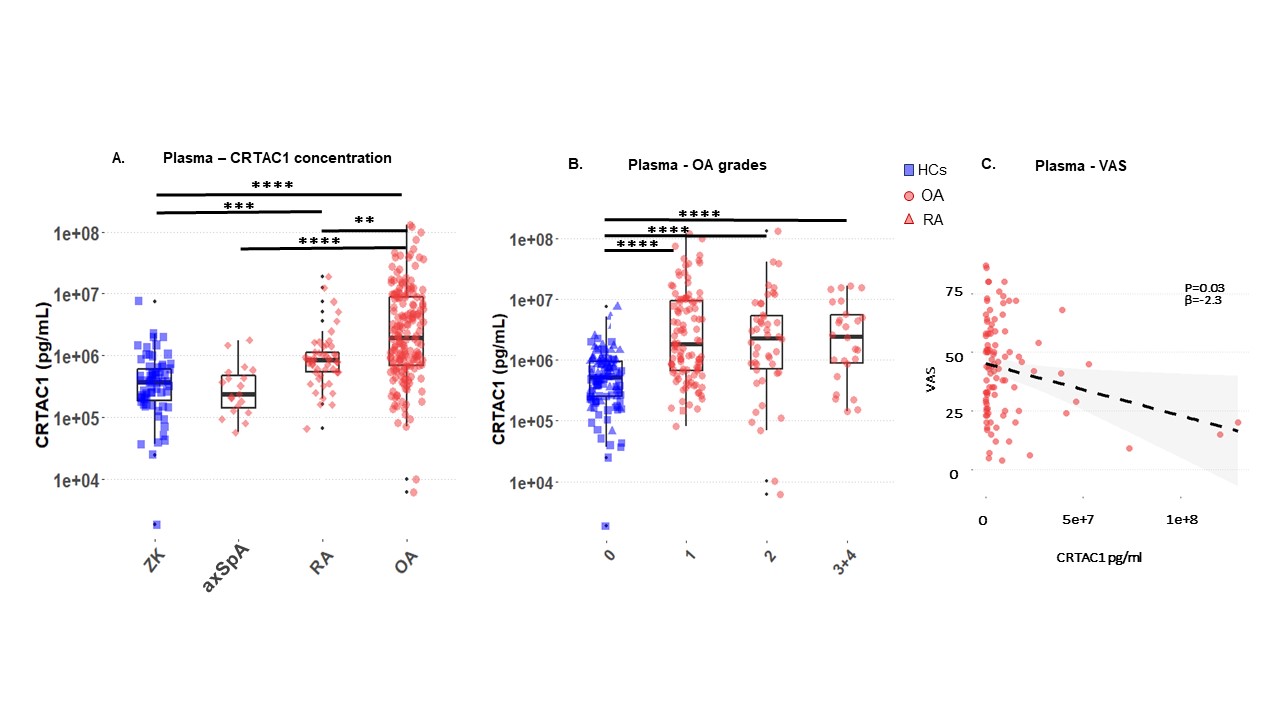
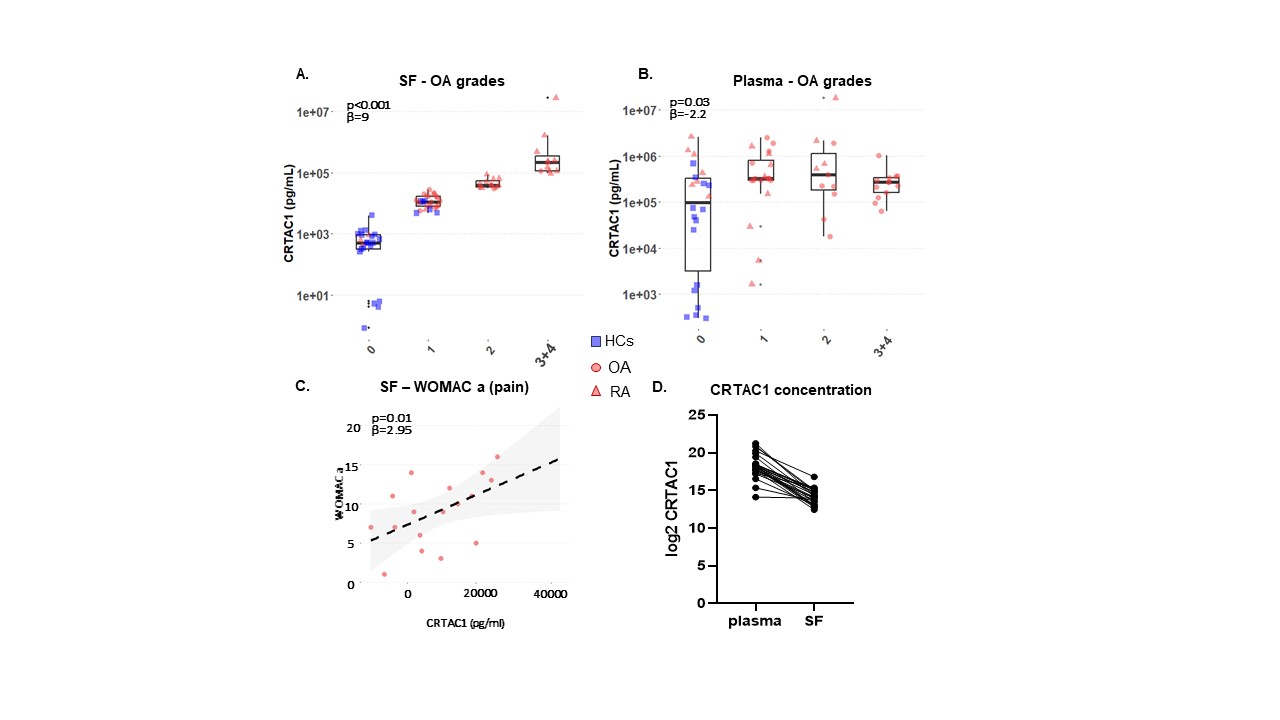
Results: CRTAC1 levels in SF and plasma were significantly higher in patients with OA compared to HCs (p< 0.001). Regression analysis showed a positive relationship between CRTAC1 levels in SF and OA severity (p< 0.001; β=9); however, systemic CRTAC1 levels showed the opposite trend (p=0.03, β=-2.2). We found a positive association between SF levels of CRTAC1 and WOMAC-A (p=0.01, β=2.95).In wider cohort, plasma CRTAC1 levels were higher in patients with OA compared to patients with RA, axSpA, and HCs (all p< 0.01). We found a negative association between systemic CRTAC1 levels and VAS pain (p=0.03, β=-2.3) in OA. There were no significant differences in CRTAC1 levels among OA subtypes.
Conclusion: This study provides the first evidence of a distinct local and systemic profile of CRTAC1 in patients with knee OA. CRTAC1 levels in synovial fluid may better reflect pain and severity of joint involvement compared to its plasma counterparts, which likely reflect other physiological and pathophysiological processes.
Acknowledgement: Supported by GAUK-266523, MHCR 023728
Reference: (1) Styrkarsdottir U, et al. The CRTAC1 Protein in Plasma Is Associated With Osteoarthritis and Predicts Progression to Joint Replacement: A Large-Scale Proteomics Scan in Iceland. Arthritis Rheumatol. 2021;73(11):2025-2034. doi:10.1002/art.41793 (2) Szilagyi IA, et al. Plasma proteomics identifies CRTAC1 as a biomarker for osteoarthritis severity and progression. Rheumatology (Oxford). 2023;62(3):1286-1295. doi:10.1093/rheumatology/keac415
A. CRTAC1 levels in SF of patients with different OA severity. B. CRTAC1 levels in paired plasma samples of patients with different OA severity. The p-values show the statistical significance of linear regression, including healthy individuals (blue, square), OA patients (red, circle) and RA patients (red, triangle). C. Association of CRTAC1 and WOMAC a (pain) in SF of OA patients, computed via linear modelling. D. Comparison of CRTAC1 concentration in paired SF and plasma samples.
A. CRTAC1 levels in a wider cohort of plasma samples in HCs and patients with axSpA, RA and OA. B. CRTAC1 levels in plasma samples of patients with different OA severity. The p-values show statistical significance between healthy individuals (blue, square), axSpA (red, rhombus), OA patients (red, circle) and RA patients (red, triangle) and were computed using ANOVA. Linear modelling did not reveal the association between CRTAC1 levels and OA severity. C. Association of CRTAC1 and VAS in the wider cohort in plasma samples, computed via linear modelling.
A. Pekacova: None; J. Baloun: None; A. Navratilova: None; L. Ondrejcakova: None; J. Zborovjanova: None; P. Fulin: None; R. Ballay: None; M. Tomcik: None; L. Senolt: None.