1718: Longitudinal Quantification of Bone Erosions, Pulmonary Disease, Pain, Gait and Sarcopenia to Holistically Assess Decreased Ad Libitum Physical Activity and Effects of Exercise in the TNF-Transgenic Murine Model of Rheumatoid Arthritis
University of Rochester Medical Center Rochester, NY, United States
Disclosure information not submitted.
Calvin Cole1, H. Mark Kenney2, Zachary Sechrist1, Yue Peng1, Kiana Chen3, Megan Falsetta1, Ronald Wood1, Homaira Rahimi4, Christopher T Ritchlin5 and Edward Schwarz4, 1University of Rochester Medical Center, Rochester, NY, 2University of Rochester School of Medicine and Dentistry, Henrietta, NY, 3University of Rochester School of Medicine and Dentistry, Rochester, NY, 4University of Rochester, Rochester, NY, 5University of Rochester Medical School, Allergy, Immunology & Rheumatology Division, Canandaigua, NY
Background/Purpose: Rheumatoid arthritis (RA) is a chronic inflammatory disease characterized by pain, swelling, and joint destruction that decreases mobility.RA patients also suffer from pulmonary disease (PD) and sarcopenia, which decrease strength and endurance for physical activity (PA).Remarkably, the ACR just released its first guidelines on exercises in conjunction with medications as an integrative management approach for RA.1However, the risk:benefit ratio of exercise on inflamed joints remains a major concern, although the most recent clinical studies demonstrate long-term benefits.2In the tumor necrosis factor transgenic (TNF-Tg) mouse model of RA, which displays joint and extra-articular sequelae of RA in a sexually dimorphic manner, we showed that voluntary wheel running is effective in improving PD, but also exacerbated joint degeneration, correlating with activity output.3, 4Coinciding with the multifactorial disease phenotype in TNF-Tg mice, running activity (distance, rate, length, and number of run bouts) significantly declined during disease progression vs. WT littermates through multiple potential contributing features, including joint degeneration, PD, pain, gait deficiency, and sarcopenia, which have not been holistically studied in RA mouse models.
Methods: To address this deficiency, we developed an automated, ad libitum wheel running tracking system to examine disease outcomes related to PA and the relationship with features of RA disease outcomes in TNF-Tg mice.To holistically quantify the independent disease variables associated with PA outcomes, we developed longitudinal outcome measures of bone erosion and PD (micro-CT),3 pain (semiautomated von Frey with the Topcat EVF system), gait (TreadScanTm), and sarcopenia (DEXA), and evaluated 8 groups of mice: male and female TNF-Tg running vs. sedentary controls, and their WT littermates.
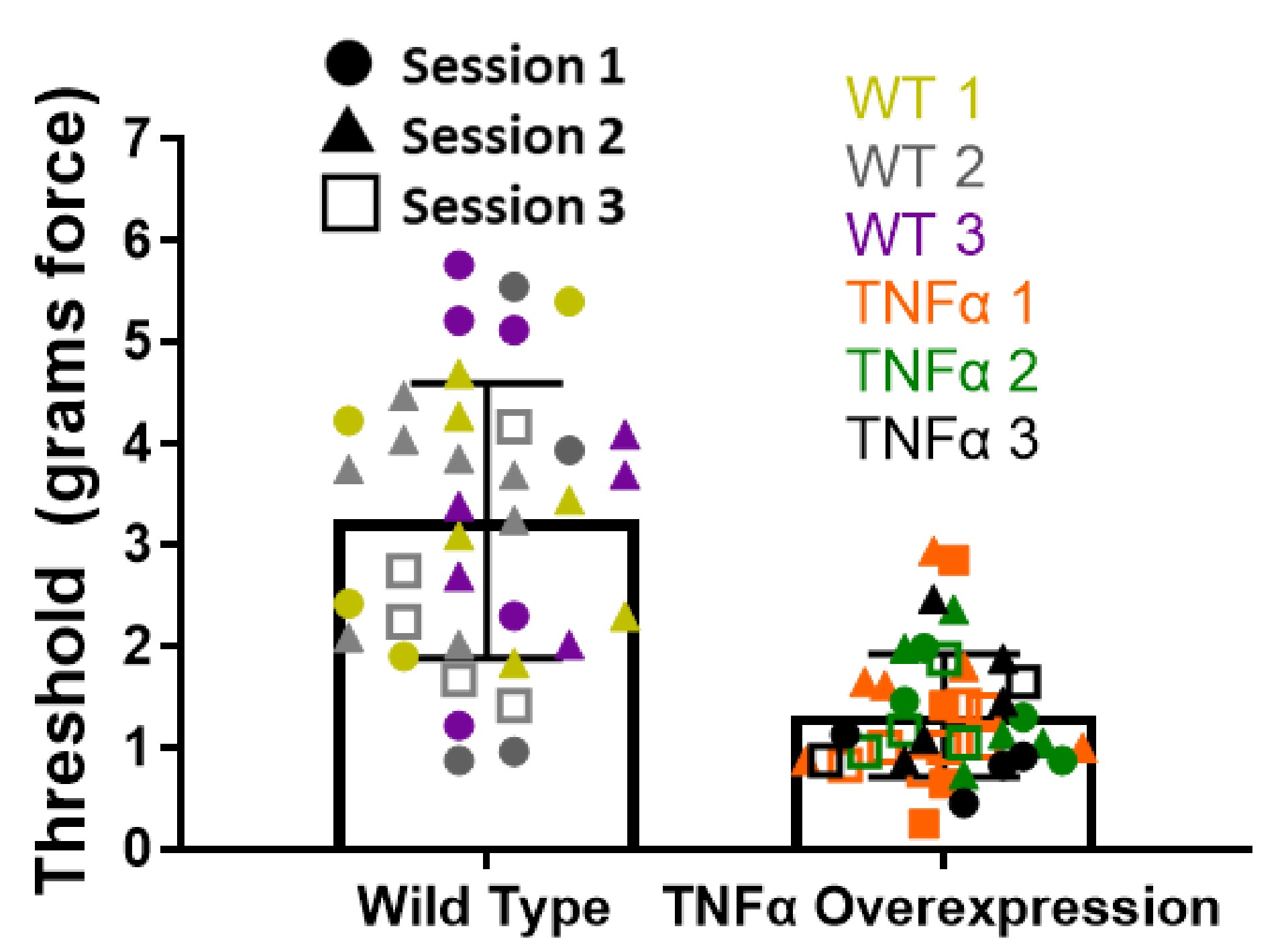
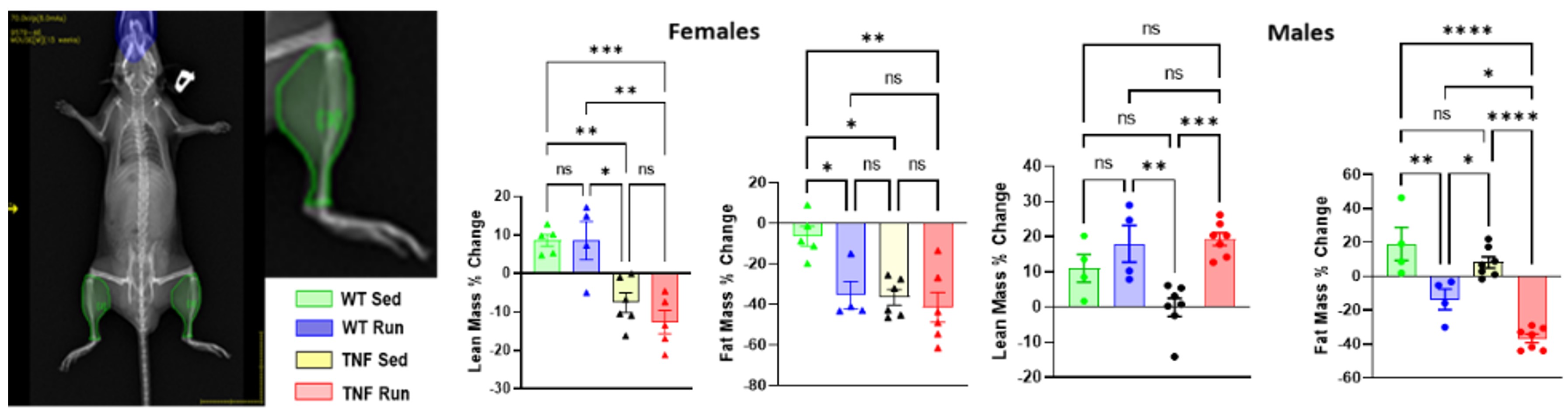
Results: Evaluation of PD revealed that running males and females increased their aerated lung volumes, which was positively correlated with running distance and rate in WT and TNF-Tg female mice,3 confirming the known efficacy of exercise on cardiopulmonary disease.5 In contrast, talus bone volumes were significantly reduced in running vs. sedentary males, and negatively correlated with running distance and rate in both male and female TNF-Tg mice.3We also found that TNF-Tg mice have reduced sensitivity thresholds indicative of pain (Figure 1, p< 0.05), decreased stride length, and reduced lean mass (Figure 2, p< 0.05) vs. WT littermates.
Conclusion: Taken together, these results demonstrate the feasibility of holistically assessing the relationship between PA and independent disease variables in murine models of arthritis. Ongoing studies will evaluate the effects of regimented exercise on the onset and progression of these various manifestations in RA towards strategic refinement and integration of non-pharmacologic treatment approaches. 1. England et al. Arthritis Rheumatol. 2023 2. Azeez et al. Clin Rheumatol. 39(6):1783-92. 2020. 3. Kenney et al. Arthr Res & Ther. 25(1):17. 2023. 4. Bell et al. Arthritis Rheumatol. 71(9):1512-23. 2019. 5. Baillet et al. Arthritis Care Res. 62(7):984-92. 2010.
Figure 1. Automated pain assessment of mice with chronic arthritis. 4-month-old male WT and TNF-Tg mice, denoted by color, were evaluated for touch sensitivity in the modified Topcat EVF system. Values were averaged from 3 testing sessions 3 days apart denoted by symbol (n=3; p=0.0002 via t-test).
Figure 2. Ad libitum wheel running alters body composition of mice in a sexually dimorphic manner. A representative scout view of a DEXA scan of a mouse is shown to illustrate segmentation of the lower hind-limb soft tissue region of interest (ROI) used for body composition studies. DEXA analyses of the % change in lean mass (muscle) and fat mass composition of WT and TNF-Tg mice from 2 to 5.5 months of age ± ad libitum wheel running are shown. Data are presented for each mouse with mean ± SD (*p<0.05, **p<0.01, ***p<0.001, ****p<0.0001, two-way ANOVA with Tukey’s multiple comparisons).
C. Cole: None; H. Kenney: None; Z. Sechrist: None; Y. Peng: None; K. Chen: None; M. Falsetta: None; R. Wood: None; H. Rahimi: None; C. Ritchlin: AbbVie, 2, 5, 6, Amgen, 2, BMS, 2, Eli Lilly, 2, Gilead, 2, Janssen, 2, Novartis, 2, Pfizer, 2, 5, 6, UCB, 2, 6; E. Schwarz: None.