Dept. of Pathophysiology, School of Medicine, University of Athens Athens, Greece
Disclosure information not submitted.
Andreas Goules1, Loukas Chatzis2, Vasileios pezoulas3, Francesco Ferro4, Valeria Manfrè5, Dimitrios Fotiadis3, Luca Quartuccio Quartuccio6, Chiara Baldini7, Salvatore De Vita5 and Athanasios Tzioufas1, 1Dept. of Pathophysiology, School of Medicine, University of Athens, Athens, Greece, 2Dept. of Pathophysiology, School of Medicine, University of Athens, Cholargos Athens, Greece, 3Unit of Medical Technology and Intelligent Information Systems, Dept. of Materials Science and Engineering, University of Ioannina, Ioannina, Greece, 4Clinical and Experimental Medicine Department, Azienda Ospedaliero-Universitaria Pisana, Pisa, Italy, 5Clinic of Rheumatology, Dept. of Medical and Biological Sciences, Udine University, Udine, Italy, 6Rheumatology Division, Department of Medicine, University of Udine, Udine, Italy, 7University of Pisa, Pisa, Italy
Background/Purpose: Lymphoma is the most serious complication of primary Sjogren's syndrome (pSS), occurring as a late sequel during disease course. So far, lymphoma predictors have been identified only at the time of pSS diagnosis in single center cohorts using classical logistic regression models. The current work aims to study the evolution of lymphoma predictors towards lymphoproliferation by employing data driven analysis on totally harmonized pSS patients.
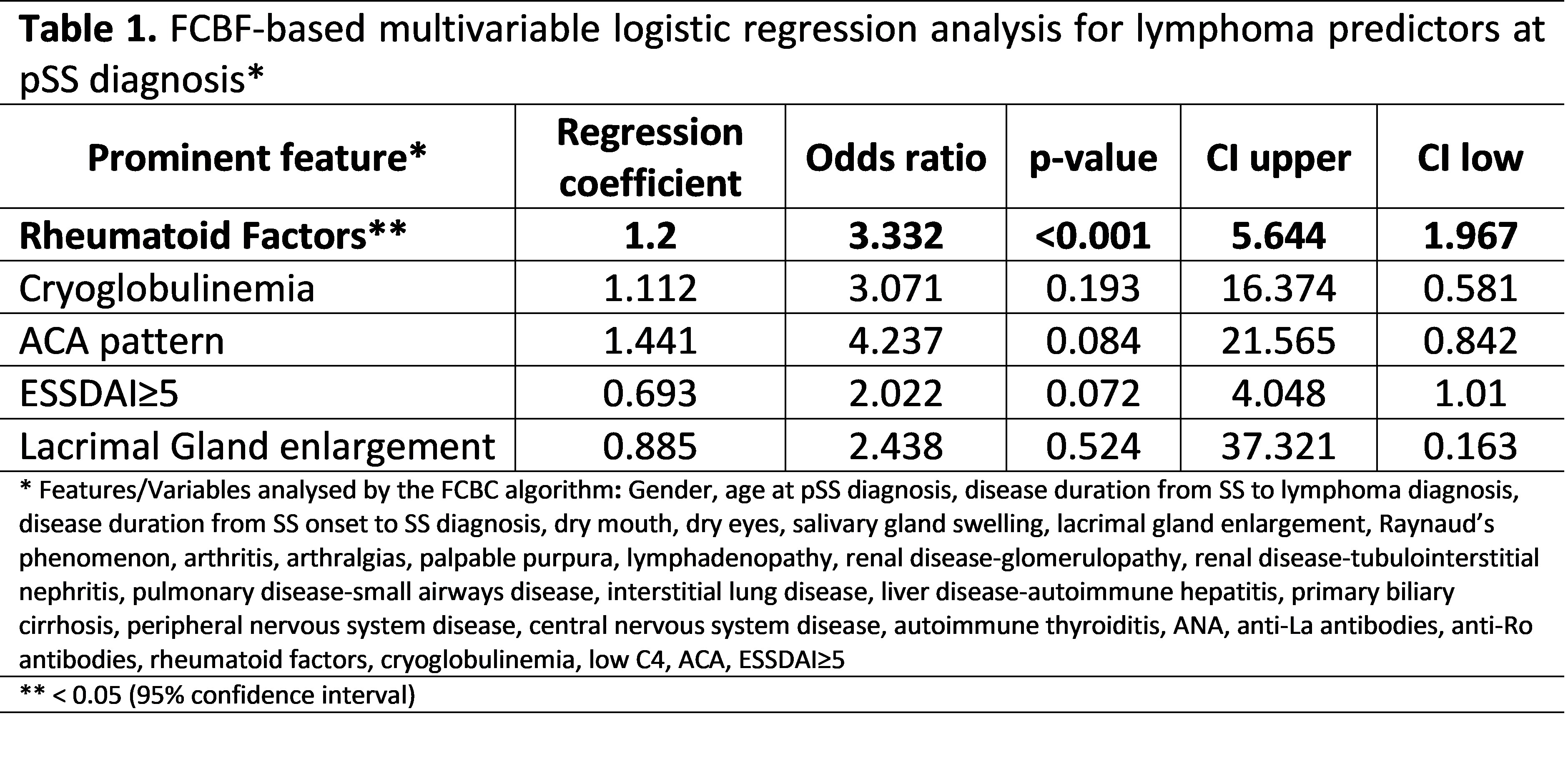
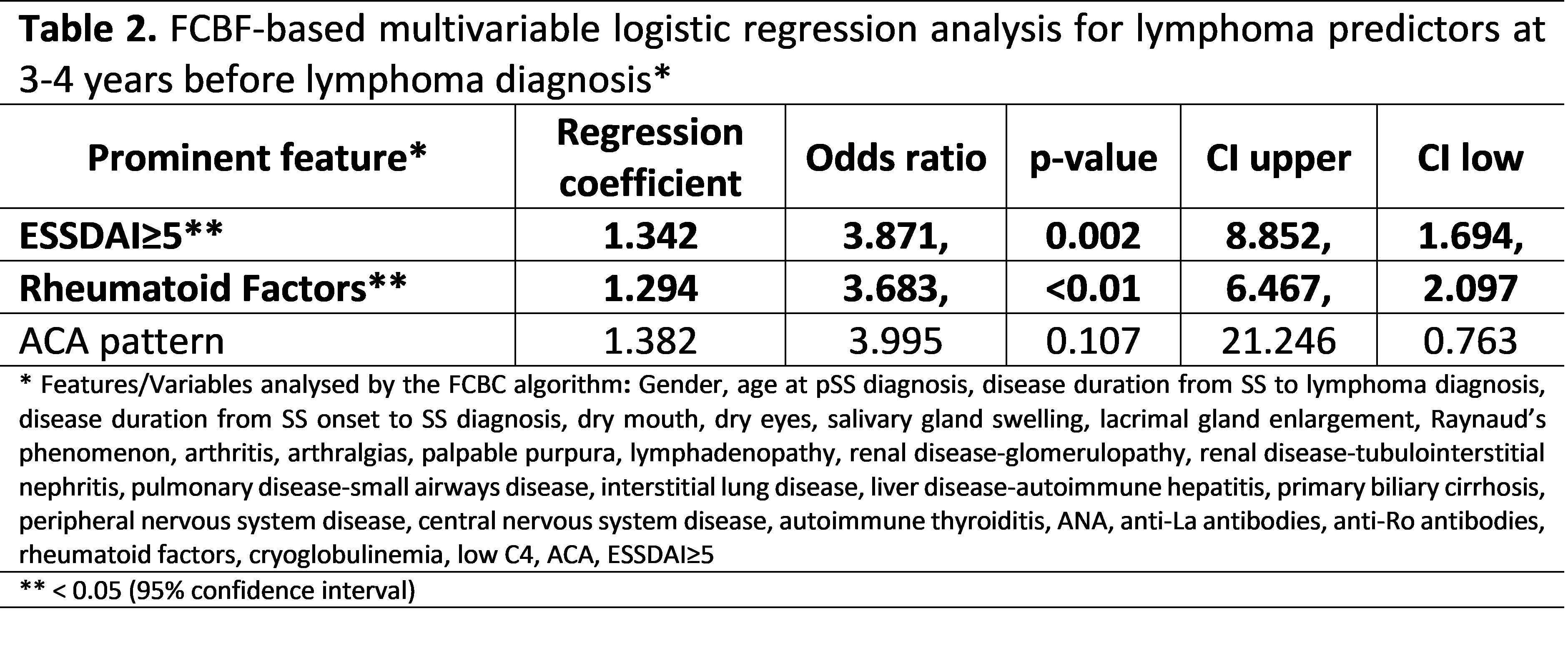
Methods: Two curated and harmonized datasets with pSS patients from3 centers (Athens, Piza, Udine) were constructed to be analyzed for lymphoma predictors at two different time points before lymphoma diagnosis. Each dataset incorporated the same set of 30 clinically useful features covering the major aspects of the disease (Table 1, 2). The first dataset included 80 lymphoma patients and non-lymphoma controls (1:1 ratio), representing the time point of pSS diagnosis and the second dataset 68 lymphoma and non-lymphoma controls (1:1 ratio) representing the time point of 3-4 years before lymphoma diagnosis. All included patients fulfilled the 2016 ACR/EULAR criteria and non-lymphoma controls were matched according to age, gender, disease duration from pSS diagnosis to last follow up and treatment modalities. Systemic manifestations were defined as described in the ESSDAI domains and for those not included in the ESSDAI system, either by tissue biopsy or by applying international consensus criteria. A Fast-Correlation based feature selection (FCBF)/logistic regression (LR) model with lymphoma as an outcome, was applied on both datasets as described previously (1).
Results: Regarding the time point of pSS diagnosis, 5 prominent features in terms of magnitude of order were identified by the FCBF algorithm as potential predictors including rheumatoid Factor (RF), cryoglobulinemia, ACA pattern, ESSDAI≥5 and lacrimal gland enlargement of which only RF was finally proven an independent lymphoma predictor (Table 1). For the second time point of 3-4 years before lymphoma diagnosis, a similar set of prominent features was found by the FCBF algorithm with the exception of lacrimal gland enlargement and cryoglobulinemia while RF and ESSDAI≥5 were identified as independent lymphoma risk factors (Table 2). Both FCBF/LR models had good overall performance after 10-fold cross validation strategy (pSS diagnosis: accuracy=63%, sensitivity=63%, specificity=63%, AUC=76% and for the second time point of 3-4 years before lymphoma diagnosis: accuracy=65%, sensitivity=65%, specificity=71%, AUC=75%).
Conclusion: Rheumatoid factor is the earliest and more persistent pSS associated lymphoma predictor while high ESSDAI≥5 in combination with RF connote an advanced stage across the lymphomagenesis process, predicting the occurrence of lymphoma in approximately 4 years before.
FCBF-based multivariable logistic regression analysis for lymphoma predictors at pSS diagnosis
FCBF-based multivariable logistic regression analysis for lymphoma predictors at 3-4 years before lymphoma diagnosis
A. Goules: None; L. Chatzis: None; V. pezoulas: None; F. Ferro: None; V. Manfrè: None; D. Fotiadis: None; L. Quartuccio: None; C. Baldini: GlaxoSmithKlein(GSK), 6, Horizon, 6, Sanofi, 6; S. De Vita: None; A. Tzioufas: None.