Abbvie Ireland, Galway University Hospital Dublin, Dublin, Ireland
Disclosure information not submitted.
Rebecca O'Farrell1, Sinead Maguire2, Louise Moore3, Kieran Murray4, Áine Gorman5, Elisabeth Ball6, Claire Riddell6, Madeline O'Neill7, Natasha Jordan8, Barry O'Shea9, Douglas Veale10, Suzanne Donnelly11, Grainne Murphy12 and Gillian Fitzgerald13, 1Department of Rheumatology, Galway, Dublin, Ireland, 2Toronto Western Hospital, Toronto, ON, Canada, 3Our Lady's Hospice and Care Services, Harold's Cross, Dublin 6W, Harold's Cross,, Ireland, 4University Hospital Limerick, Limerick, Ireland, 5Royal United Hospital, Bath, United Kingdom, 6Belfast Health and Social Care Trust, Belfast, United Kingdom, 7Our Lady's Hospice, Harold's Cross, Dublin, Ireland, 8Addenbrooke's Hospital, Cambridge, United Kingdom, 9St James's Hospital, Dublin, Ireland, 10St.Vincent's University Hosp, Dublin, Ireland, 11Mater Misericordiae University Hospital, Dublin, Ireland, 12Cork University Hospital, Cork, Ireland, 13University Hospital Galway, Galway, Ireland
Background/Purpose: Rheumatic disease frequently affects women of childbearing age. Women with pre-existing rheumatic disease who are planning a pregnancy or develop these conditions during pregnancy often require specialist input from maternal-foetal medicine and Rheumatology. The aim of this study is to establish current practices regarding the management and monitoring of women with RMD (Rheumatic and Musculoskeletal disease) in Ireland and to identify current challenges.
Methods: In March 2023, a 17-question anonymised online survey was distributed using a well-recognised electronic survey tool. Rheumatology consultants, Registrars, Clinical Nurse Specialists (CNS), advanced nurse practitioners (ANP) and Allied health professionals currently working in a rheumatology unit in Ireland were invited to participate. The survey collected demographics and data focusing on current delivery of care in place for pregnant women with RMD in Irish rheumatology units. SPSS was used for statistical analysis.
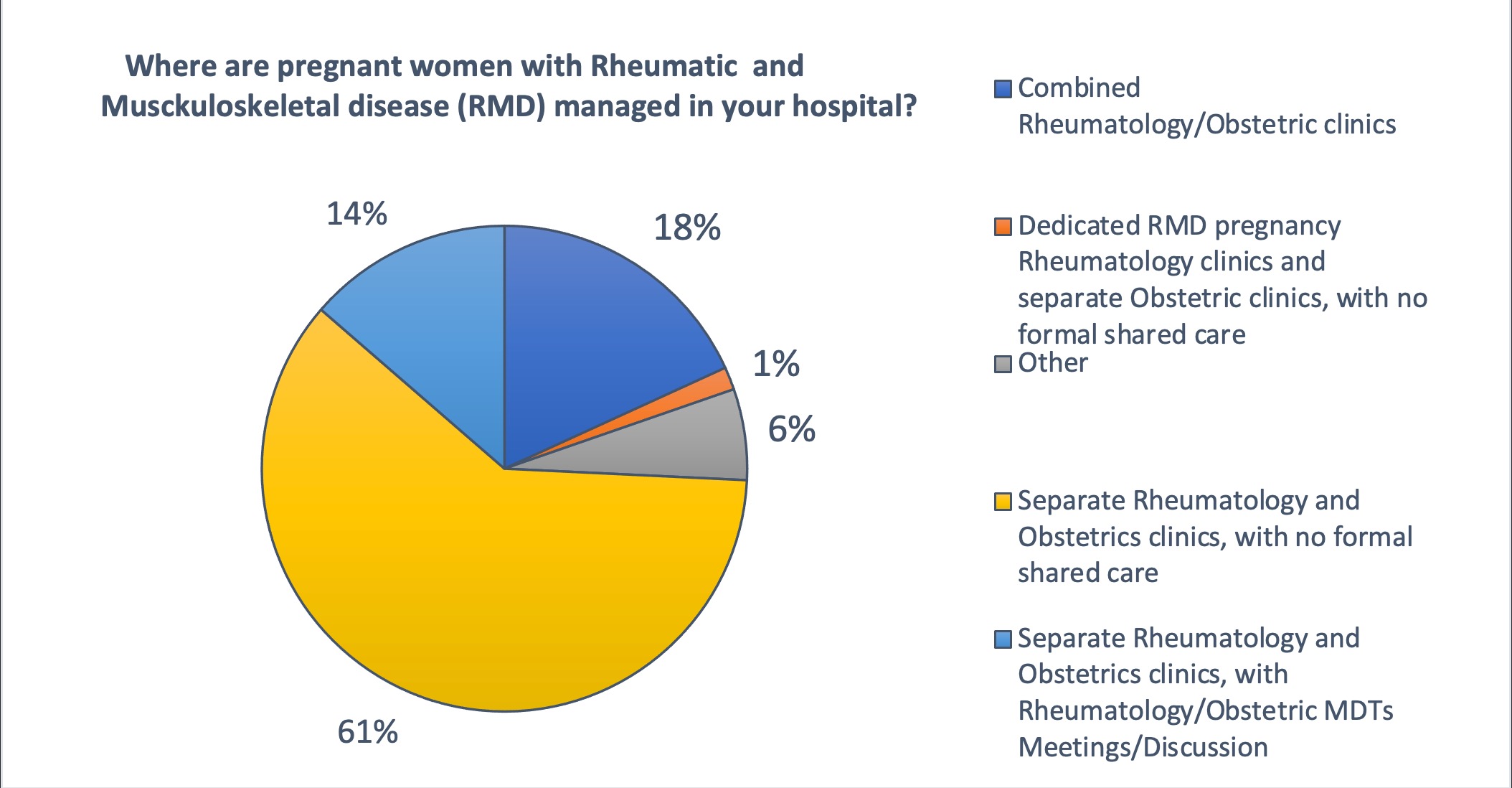
Results: The response rate was 69 %: 82% (n=54) female, 29% (n=19) Consultant Rheumatologists, 18% (n=12) Registrars, 27% (n=18) CNS, 20% (n=13) ANPs. Significant variability exists across clinical sites for pregnancy care delivery in RMD, with combined rheumatology/obstetric clinics occurring in only 18% of units (Figure 1). Preconception counselling is conducted in the General Rheumatology Clinic setting in 61% (n=40) of hospitals. In 41 % (n=27) of centres, women with RMD are reviewed once per trimester and 27 % (n=18) of centres reported no change to pre-pregnancy care. Less than 5 % (n=3) of clinical centres arranged monthly reviews during pregnancy. In 56% (n=37) of hospitals, there is no named Obstetrician for managing complex RMD patients during pregnancy.
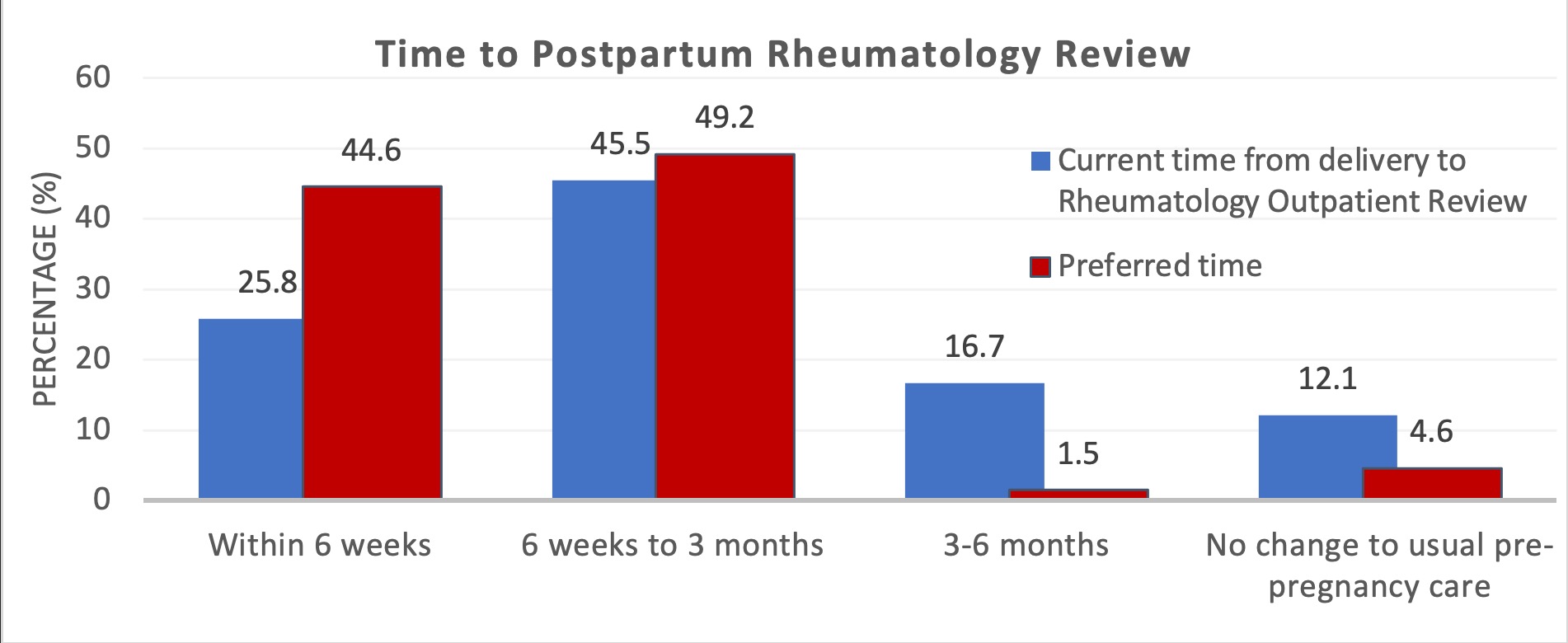
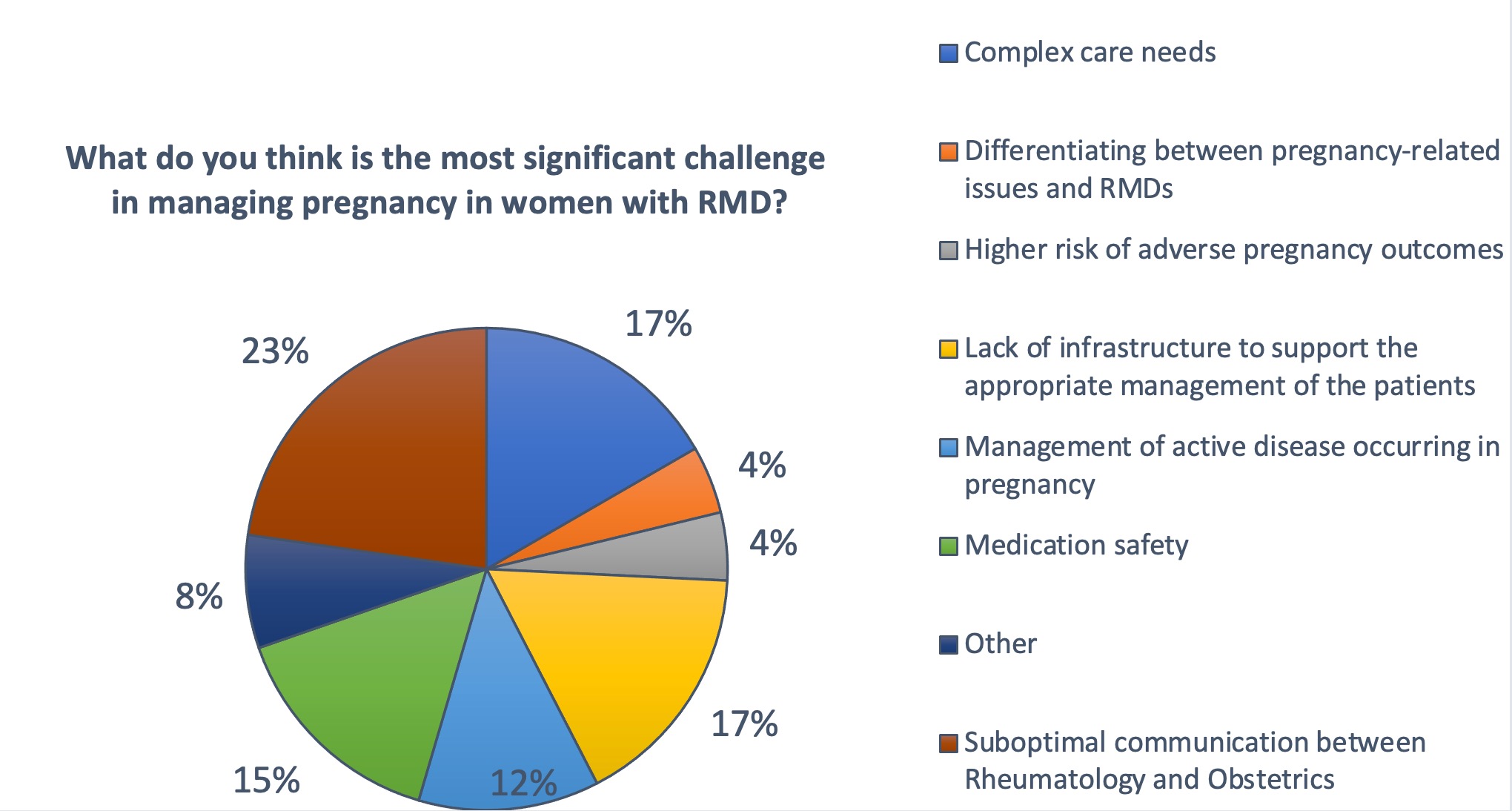
The majority 49% (n=32) of respondents wished to review patients between 6 weeks and 3 months post-delivery and 46% (n=30) of centres reported offering clinical reviews in this period at present (Figure2). In 12 % (n=8) centres, clinicians offered no change to pre-pregnancy care. Professional healthcare role had no association with time to review post-delivery (p >0.05). Challenges identified in delivering desired care included suboptimal communication between Rheumatologists and Obstetricians (23 %, n=15), complex care needs of patients (17 %, n=11), suboptimal infrastructure (17 %, n=11) (Figure 3). Common barriers to implementing a dedicated clinic included lack of clinical space (62 %, n=41), insufficient staffing (46 %, n=30) and maternity hospital not co-located with main hospital (50%, n=33).
Conclusion: Significant variation in the delivery of care for pregnant women with RMD is identified in this survey. The delivery of care to patients with RMD may be limited by deficiencies in our current healthcare setting. The development of a national framework for management and monitoring of women with RMD during their pregnancy would unify care, promoting optimisation of maternal health, control of disease and neonatal outcomes.
Figure 1.
Figure. 2
Figure 3.
R. O'Farrell: None; S. Maguire: None; L. Moore: None; K. Murray: None; Á. Gorman: None; E. Ball: None; C. Riddell: None; M. O'Neill: None; N. Jordan: None; B. O'Shea: None; D. Veale: None; S. Donnelly: None; G. Murphy: None; G. Fitzgerald: None.