Istanbul Faculty of Medicine, Istanbul University İstanbul, Turkey
Disclosure information not submitted.
Erdem Gurel1, Suzan Cinar2, Ozge Hurdogan3, Yasemin Ozluk3, Isin Kilicaslan4, Sibel Varelci1, Safak Mirioglu5, Yasemin Yalcinkaya6, Ahmet Gul6, Lale Ocal1, Murat Inanc6 and Bahar Artim-Esen6, 1Division of Rheumatology, Istanbul University Istanbul School of Medicine, Istanbul, Turkey, 2Department of Immunology, Aziz Sancar Institute of Experimental Medicine, Istanbul University, Istanbul, Turkey, 3Department of Pathology, Istanbul University Istanbul School of Medicine, Istanbul, Turkey, 4Department of Pathology, Istanbul University Istanbul School of Medicine, Istanbıl, Turkey, 5Division of Nephrology, Bezmialem Vakif University School of Medicine, Istanbul, Turkey, 6Division of Rheumatology, Department of Internal Medicine, Istanbul Faculty of Medicine, Istanbul University, Istanbul, Turkey
Background/Purpose: CD163 is a glycosylated membrane protein expressed in monocytes and macrophages that phagocytize the hemoglobin/haptoglobin complex. As a result of proinflammatory stimuli, CD163 is shedded from the cell membrane and becomes soluble CD163. Therefore, it has been shown that serum (s) and urine (u) levels of soluble CD163 increase in acute or chronic inflammatory diseases. sCD163 and uCD163 are considered as potential biomarkers reflecting disease activity in patients with systemic lupus erythematosus (SLE).We aimed to investigate the association of serum and urine soluble CD163 levels and renal CD163 expression with disease activity in patients with lupus nephritis (LN).
Methods: Serum and urine levels of CD163 of 45 SLE patients (active renal 20, active non-renal 15, inactive 10) and 20 healthy volunteers were tested by ELISA. Control samples were taken from 12 active renal patients after six months of treatment and 30 renal biopsy specimens were examined for CD163 expression.
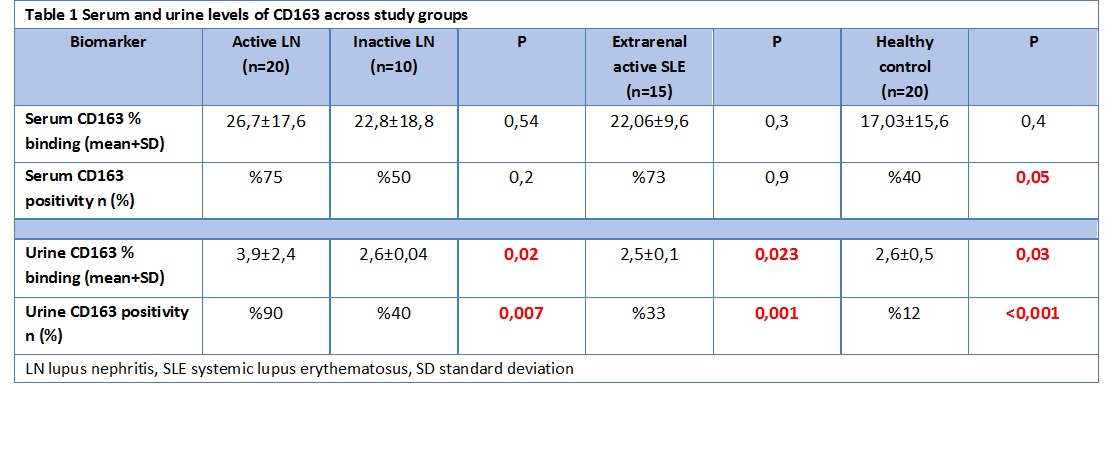
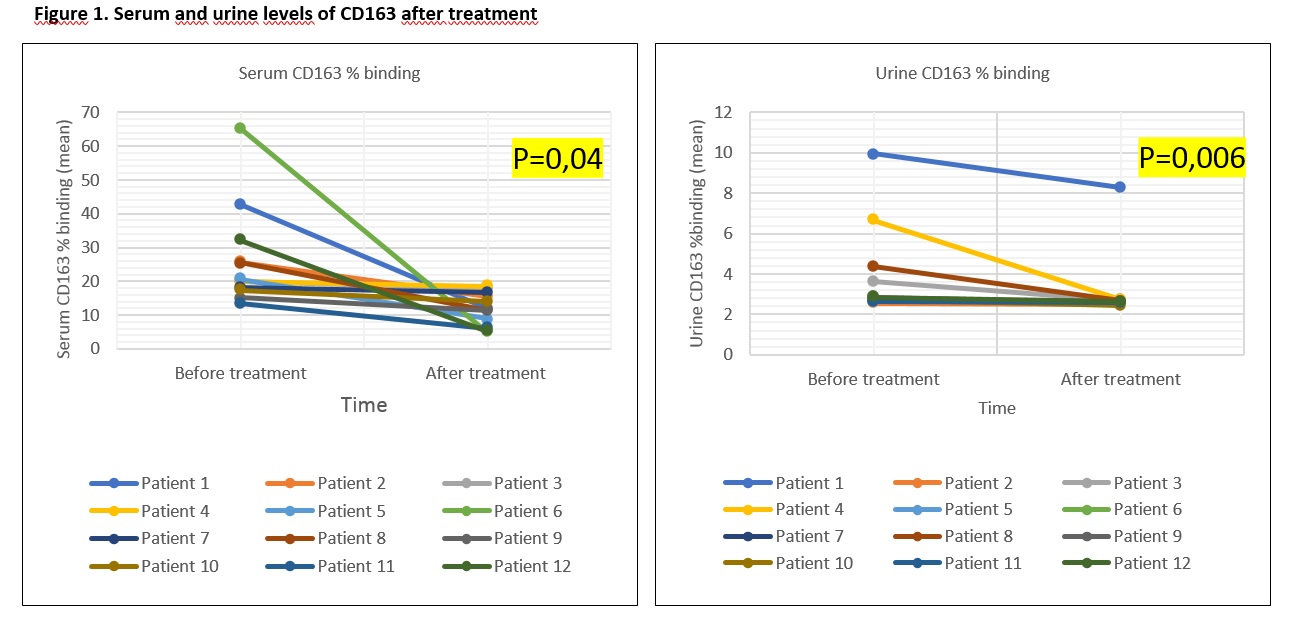
Results: Of 45 participants, 37 (82.2%) were female, with a median disease duration of 113 (1-436) months and a mean age of 38,9±13 (18-68) years. Both the frequency of uCD163 positivity and its levels were significantly higher in the active LN group compared to the inactive LN (p=0,007 and 0.02 respectively) and active non-renal SLE (p=0,001 and 0.023 respectively) groups (Table 1). sCD163 and uCD163 levels of 12 patients with active LN were significantly reduced after treatment (p=0,04 and p=0,006) (Figure 1). CD163+ macrophage expression in kidney biopsies of patients with active LN correlated with sCD163 (r= 0.597 and p=0.01) and uCD163 (r=0.507 and p=0.045) levels.
Conclusion: uCD163 is a promising biomarker that can differentiate active LN from inactive LN and active extrarenal SLE changing in line with treatment response. Correlation of both s and uCD163 with CD163+ macrophage expression in biopsies suggests that it may be used as an activity parameter in patients with lupus nephritis histopathologically. Further studies are awaited to confirm these results.
Table 1. Serum and urine levels of CD163 across study groups
Figure 1. Serum and urine levels of CD163 after treatment
E. Gurel: None; S. Cinar: None; O. Hurdogan: None; Y. Ozluk: None; I. Kilicaslan: None; S. Varelci: None; S. Mirioglu: None; Y. Yalcinkaya: None; A. Gul: None; L. Ocal: None; M. Inanc: None; B. Artim-Esen: None.