Session: (0252–0282) Miscellaneous Rheumatic & Inflammatory Diseases Poster I
0270: Exploring the Potential of Oral Administration of 5-aminolevulinic Acid/sodium Ferrous Citrate in Adult-onset Still's Disease: Preclinical Study in Mice and Pilot Investigation in Humans to Assess Efficacy and Safety
Tomohiro Koga1, Remi Sumiyoshi1, Yoshika Tsuji1, Ken Kodama2, Kaori Furukawa1, Yushiro Endo1 and Atsushi Kawakami3, 1Department of Immunology and Rheumatology, Division of Advanced Preventive Medical Sciences, Nagasaki University, Nagasaki, Japan, 2Neophama Japan, Tokyo, Japan, 3Nagasaki University, Nagasaki, Japan
Background/Purpose: The primary objective of this study is to elucidate the therapeutic potential of 5-aminolevulinic acid/sodium ferrous citrate (5-ALA/SFC) in ameliorating the pathological manifestations associated with adult-onset Still's disease (AOSD), with a specific focus on arthritis and macrophage activation syndrome (MAS). This investigation entails the utilization of mouse models to examine the impact of 5-ALA/SFC on the aforementioned pathologies in AOSD. Additionally, a pilot study involving patients diagnosed with AOSD was conducted to further assess the therapeutic efficacy and safety of 5-ALA/SFC in a clinical setting.
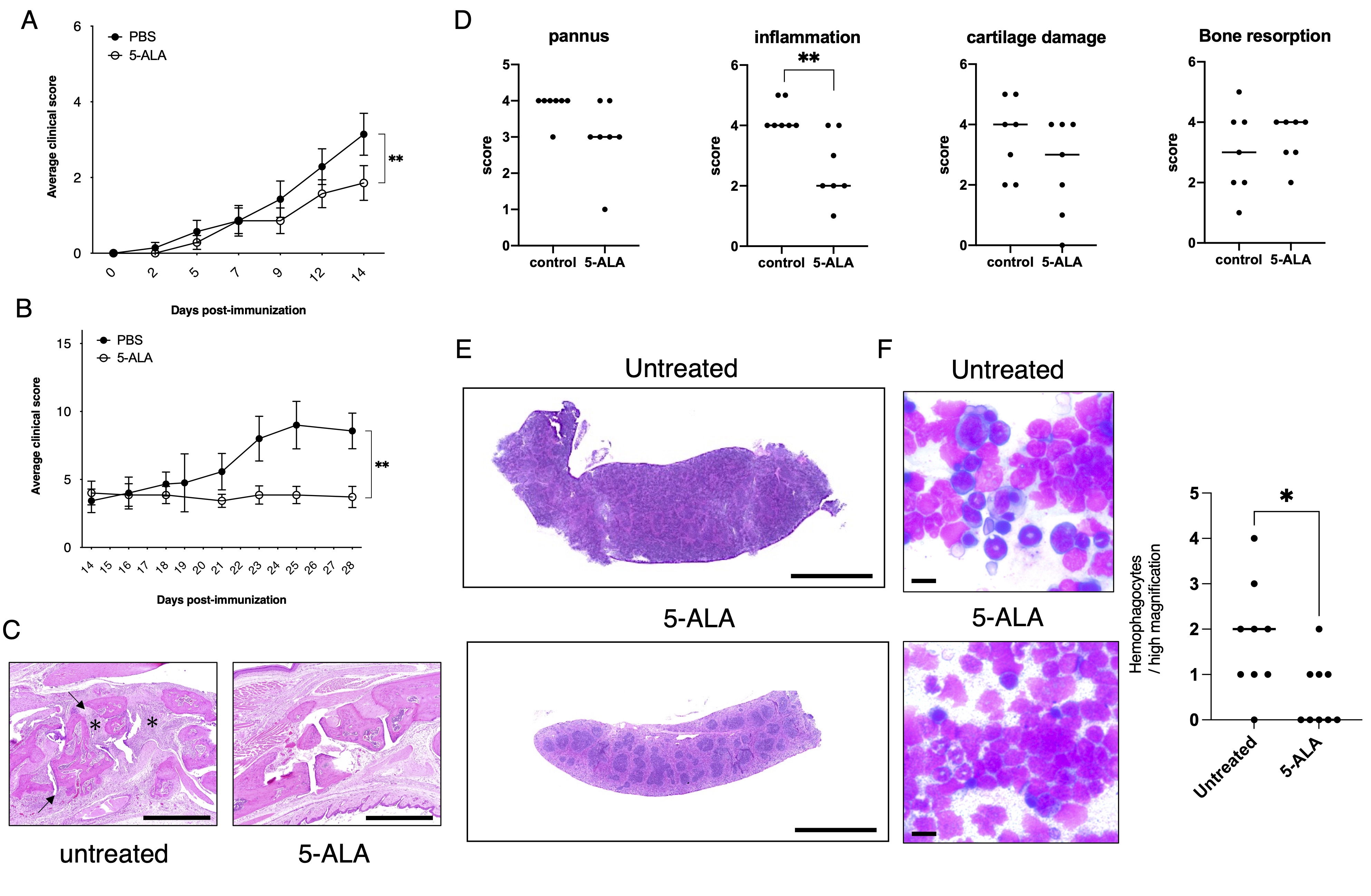
Methods: In this study, mice were subjected to collagen-induced arthritis (CIA) by immunization with type II collagen, and to MAS by repeated administration of stimulating synthetic oligonucleotides containing CpG motifs (CpG-S-ODN) via drinking water. The objective of this investigation was to assess the preventive and therapeutic effects of 5-ALA/SFC on arthritis in CIA mice, as well as its potential to ameliorate hemophagocytosis observed in bone marrow smears of CpG-S-ODN-treated mice. AOSD patients undergoing prednisolone (PSL) treatment were enrolled in an open-label trial, wherein oral administration of 5-ALA/SFC was conducted. The efficacy and safety of 5-ALA/SFC in facilitating prednisolone tapering were subsequently evaluated.
Results: In both experimental models for arthritis prevention and treatment, the group receiving 5- 5-ALA/SFC exhibited significantly reduced joint scores compared to the control group. Furthermore, in mice treated with CpG-S-ODN, the 5-ALA/SFC group demonstrated a decrease in hemophagocytosis (phagocytosis of red blood cells by immune cells) and splenomegaly (enlarged spleen). The anti-inflammatory properties of 5-ALA/SFC are attributed to its ability to suppress the production of CCL4 and CXCL10 in monocytes and macrophages, while also promoting the induction of M2 macrophages (a type of anti-inflammatory macrophage). These cellular responses contribute to the observed therapeutic effects. In the clinical study, four out of five participants completed the prescribed drug administration, and all patients successfully maintained a tapering regimen of PSL without experiencing any serious adverse events or worsening of symptoms throughout the study duration.
Conclusion: The administration of 5-ALA/SFC holds promise as a viable therapeutic intervention for inflammatory disorders, specifically AOSD. The utilization of 5-ALA/SFC may impart a multifaceted therapeutic impact, encompassing the regulation of arthritis symptoms and the suppression of MAS. Furthermore, our findings provide supporting evidence regarding the safety profile associated with 5-ALA/SFC treatment in individuals diagnosed with AOSD. However, further investigations are warranted to elucidate the underlying mechanisms and evaluate the clinical efficacy of 5-ALA/SFC, which should be pursued in future scientific inquiries.
T. Koga: None; R. Sumiyoshi: None; Y. Tsuji: None; K. Kodama: None; K. Furukawa: None; Y. Endo: None; A. Kawakami: None.