Marie Binvignat1, Brenda Miao2, Camilla Wibrand3, Monica Yang4, Dmitry Rychkov5, Emily Flynn4, Umair Khan4, Joanne Nititham6, Alex Carvidi4, Melissa Krueger4, Erene Niemi4, Yang Sun4, Gabriella Fragiadakis4, David Klatzmann1, Jeremie SELLAM7, Encarnita Mariotti-Ferrandiz1, Andrew Gross4, Chun Jimmie Ye4, Atul Butte4, Lindsey Criswell6, Mary Nakamura8 and Marina Sirota5, 1Sorbonne Université, Paris, France, 2University of California San Francisco, Fremont, CA, 3Aarhus University, Aarhus, Denmark, and University of California San Francisco, San Francisco, CA, 4University of California San Francisco, San Francisco, CA, 5Bakar Computational Health Sciences Institute, University of California San Francisco, San Francisco, CA, 6NIH/NHGRI, Bethesda, MD, 7Sorbonne Université APHP, Paris, France, 8UCSF/SFVAHCS, San Francisco, CA
Background/Purpose: Single cell transcriptional profiling (scRNA-Seq) is valuable in identifying gene signatures and cell subpopulations associated with rheumatoid arthritis (RA). However prior studies have often overlooked important demographic confounders and not focused on non-remission and difficult to treat RA. The aim of this study is to identify peripheral blood mononuclear cells (PBMCs) of RA and disease-activity cell subsets and gene signatures in a diverse population of patients.
Methods: 10X Chromium single cell sequencing was performed on peripheral blood mononuclear cells (PBMC) from 18 early RA patients and 18 healthy controls matched on age, sex, race and ethnicity. Data were processed using standard CellRanger and Scanpy pipelines, with HarmonyPy for batch correction. Differential expression (DE) was computed using pseudobulk analysis and DESeq2. Pathway analysis was carried out with over-representation analysis (ORA). Mann-Whitney tests were used to assess differences in cell proportions between matched RA and control samples, as well as between RA patients with low disease activity or remission (DAS28-CRP< 3.2; n=9) versus moderate or high disease activity (DAS28 CRP≥3.2;n=7). Ligand-receptor interaction analysis was performed using Cellchatdb.
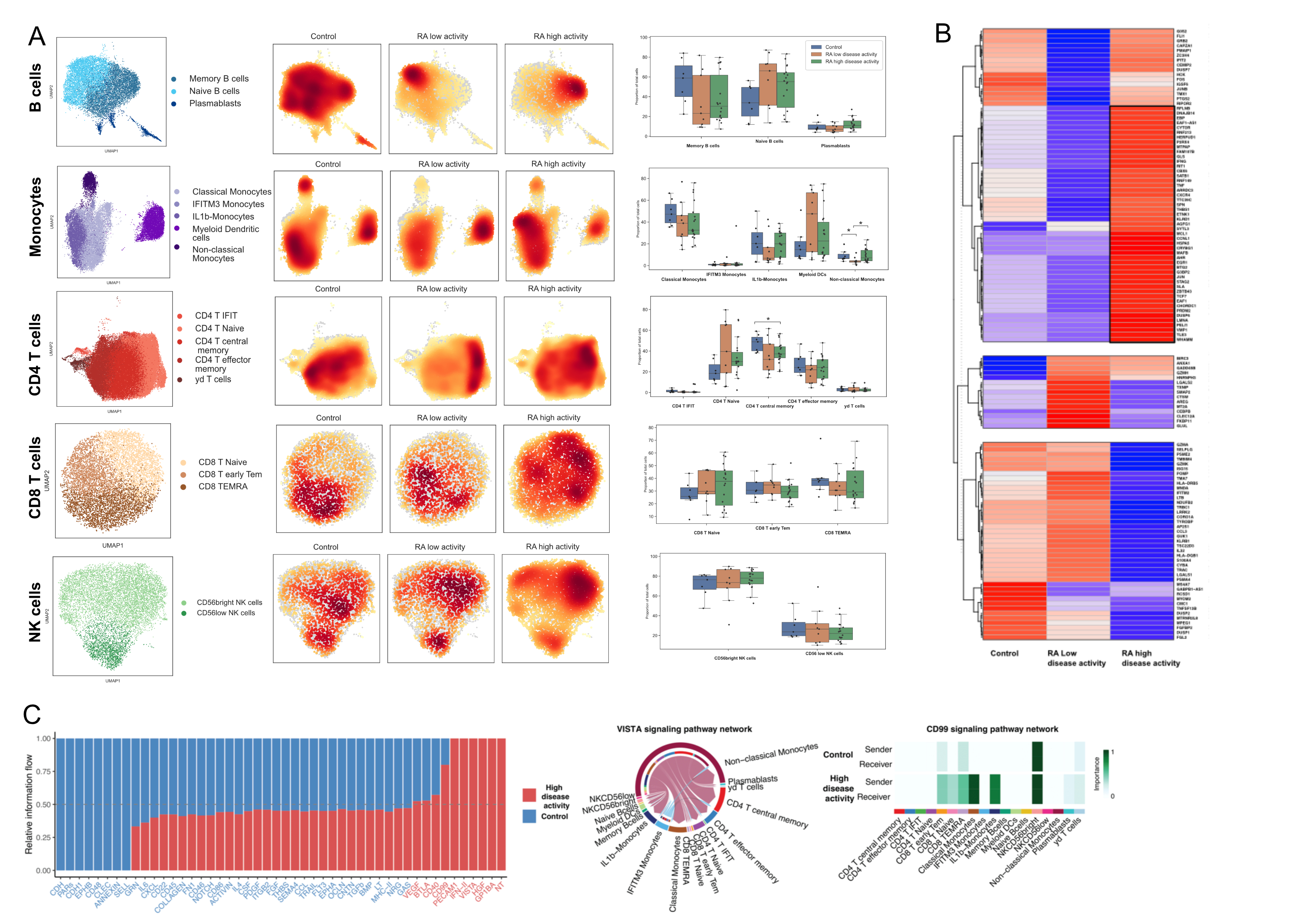
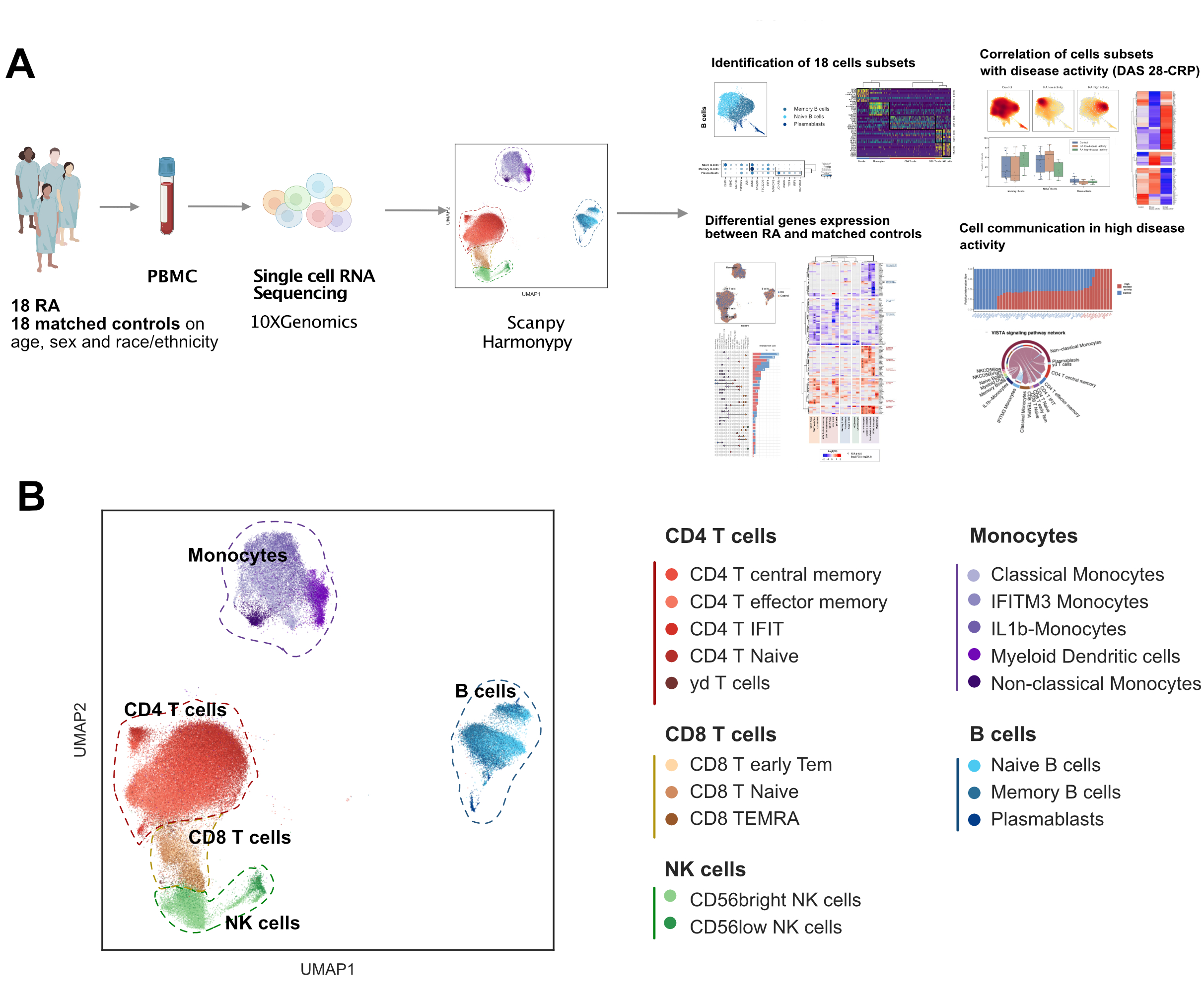
Results: The final dataset consisted of 22,159 genes across 125,698 cells. We identified 18 PBMC subsets, including 5 CD4+ T cell subsets, 3 CD8+ T cell subsets, 2 Natural Killer cell subsets, 3 B cell subsets, and 5 monocyte subsets (Figure 1). Within these subsets, IFIT CD4 T+ cells and IFITM3 monocytes were associated with Interferon-gamma response. 168 genes were DE between RA and matched controls (FDR≤0.05, foldchange >1.6). We identified up-regulation of pro-inflammatory genes associated with monocyte subsets and downregulation of inflammatory genes in gamma-delta T cells. Several genes associated with RA predisposition such as HLA-DRB5 and HLA-DQB1 were specifically downregulated in IFITM3 monocytes (Figure 2). Functional analysis and ORA highlighted significant enrichment of B cell activation and B cell receptor signaling pathways. Differences in cell subset proportions between patients with high and moderate activity, patients in low disease activity and remission, and healthy controls (n=18, Figure 3) were also observed. Non classical monocytes and T central memory were decreased in patients with high disease activity compared to control and high disease activity (p=0.022; p=0.034). We also identified a specific signature of 49 genes, including IFNG, TNF, KLRD, EGR1, CBX6, CXCR4, JUN, and TLE3, that was significantly associated with disease activity. Finally, cell communication analysis between patients with high disease activity and controls revealed upregulation of IFN-II, VEGF, VISTA, BTLA, and CD40 pathway signaling.
Conclusion: Here we describe a dataset of scRNA-Seq PBMCs from a diverse population of patients with RA and matched healthy controls. We identify differentially expressed genes and cell subsets linked to disease activity, providing insights into RA pathophysiology and potentially new therapeutic targets.
Figure 1 | A. Graphical Abstract. B. UMAP embeddings and subset annotations of single cell RNAseq dataset from patients with rheumatoid arthritis (n=18) and healthy controls (n=18) matched on age, sex, and ethnicity. CD, Cluster differentiation; DCs, Dendritics cells; IFIT, Interferon Induced proteins with Tetratricopeptide repeats; IFITM, interferon-induced transmembrane; Tem: T effector memory, TEMRA: Terminally differentiated effector memory. RA Rheumatoid ArthritisTem: T effector memory, TEMRA: Terminally differentiated effector memory. RA Rheumatoid Arthritis
Figure 2 | A. Single cell UMAP projection of patients with rheumatoid arthritis and matched controls. . B Differentially expressed genes between patients with RA and matched controls. C. Upsets pot of upregulated and downregulated genes. CD, Cluster differentiation; DCs, Dendritics cells; IFIT, Interferon Induced proteins with Tetratricopeptide repeats; IFITM, interferon-induced transmembrane; Tem: T effector memory, TEMRA: Terminally differentiated effector memory. RA Rheumatoid Arthritis
Figure 3 | A. Compositional, density and cell proportion analysis between control patients with low disease and high activity (Mann-Whitney - Wilcoxon p≤ 0.05). B. Genes expression heatmap between controls and RA with low and high disease activity and average expression across cell subtypes C. Communication pathway significantly up and downregulated in high disease activity and controls, overview of cell communication within the VISA and the CD99 pathway. CD, Cluster differentiation; DCs, Dendritics cells; IFIT, Interferon Induced proteins with Tetratricopeptide repeats; IFITM, interferon-induced transmembrane; Tem: T effector memory, TEMRA: Terminally differentiated effector memory. RA Rheumatoid Arthritis
M. Binvignat: None; B. Miao: None; C. Wibrand: AMBU, 11, GenMab, 11, Lundbeck, 11, NovoNordisk, 11; M. Yang: None; D. Rychkov: None; E. Flynn: None; U. Khan: None; J. Nititham: None; A. Carvidi: None; M. Krueger: None; E. Niemi: None; Y. Sun: None; G. Fragiadakis: None; D. Klatzmann: None; J. SELLAM: None; E. Mariotti-Ferrandiz: None; A. Gross: None; C. Ye: Chan Zuckerberg Initiative, 5, Genentech, 5, ImmunAI, 1, 8, Maze Therapeutics, 2, 8, Related Sciences, 1, 8, TReX Bio, 2; A. Butte: 10X Genomics Health, 2, Genentech, 1, Mango Tree, 2, Merck/MSD, 1, Novartis, 1, NuMedii, 2, 8, personalis, 2, 4, 8, Roche, 1, samsung, 2, Verinata (Illumina), 2; L. Criswell: None; M. Nakamura: None; M. Sirota: Exxagen, 1.



.jpg)