Elodie Portier1, Maxime Dougados2, Adeline Ruyssen-Witrand3 and Anna Molto4, 1Hôpital Cochin, Paris, France, 2Rheumatology Department, Cochin Hospital; INSERM (U1153): Clinical Epidemiology and Biostatistics, University of Paris, Paris, France, 3Toulouse University Hospital, Toulouse, France, 4HOPITAL COCHIN AP-HP, Service de Rhumatologie, Paris, France
Background/Purpose: Axial spondyloarthritis (axSpA) is typically characterized by imaging (radiographs or MRI) abnormalities of the sacroiliac joints (SIJ). Also, inflammatory lesions of the SIJ have been observed in healthy women post-partum. However, the impact of pregnancy on imaging abnormalities in women with axSpA is unknown.
The objective of this study was to evaluate impact of pregnancy on SIJ imaging in patients with early axSpA.
Methods: Women with axSpA from the French prospective cohort DESIR were included, with a follow-up of 5 years. Description of demographic and disease criteria, and SIJ imaging abnormalities at baseline was performed in all women, then according to antecedent of pregnancy. Secondly, changes on imaging over time were analyzed in the 38 women who were nulligravidae at baseline and became pregnant during follow up, using paired-test and then mixed models.
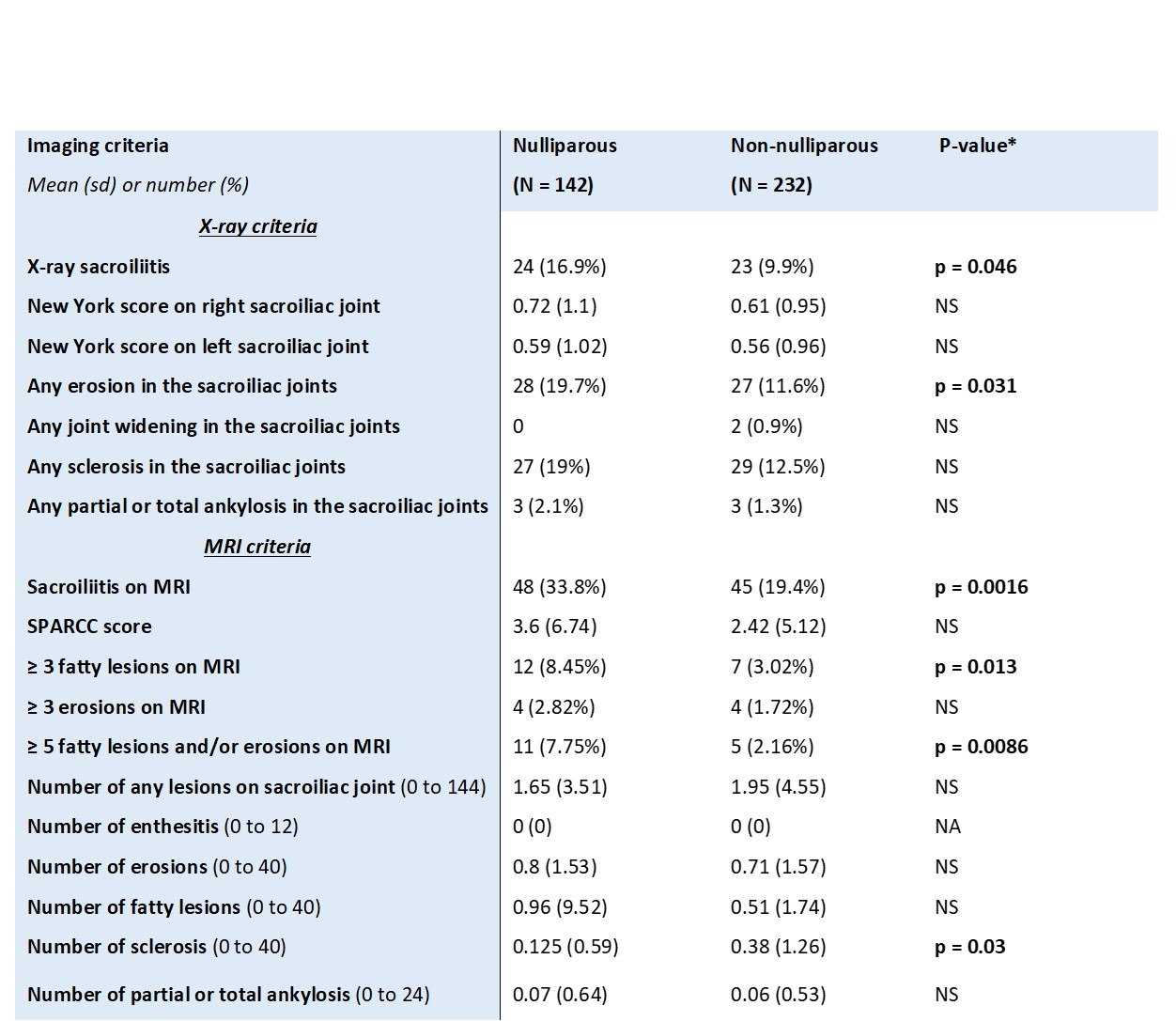
Results: 381 patients were included in the analysis. At baseline, women nulligravidae (142, 37%) were younger and had higher education level than other women with axSpA. Presence of sacroiliitis on MRI and X-ray were more frequent in women nulligravidae (16.9% vs 9.9%, p = 0.046 and 33.8% vs 19.4%, p = 0.0016, respectively) (table 1).
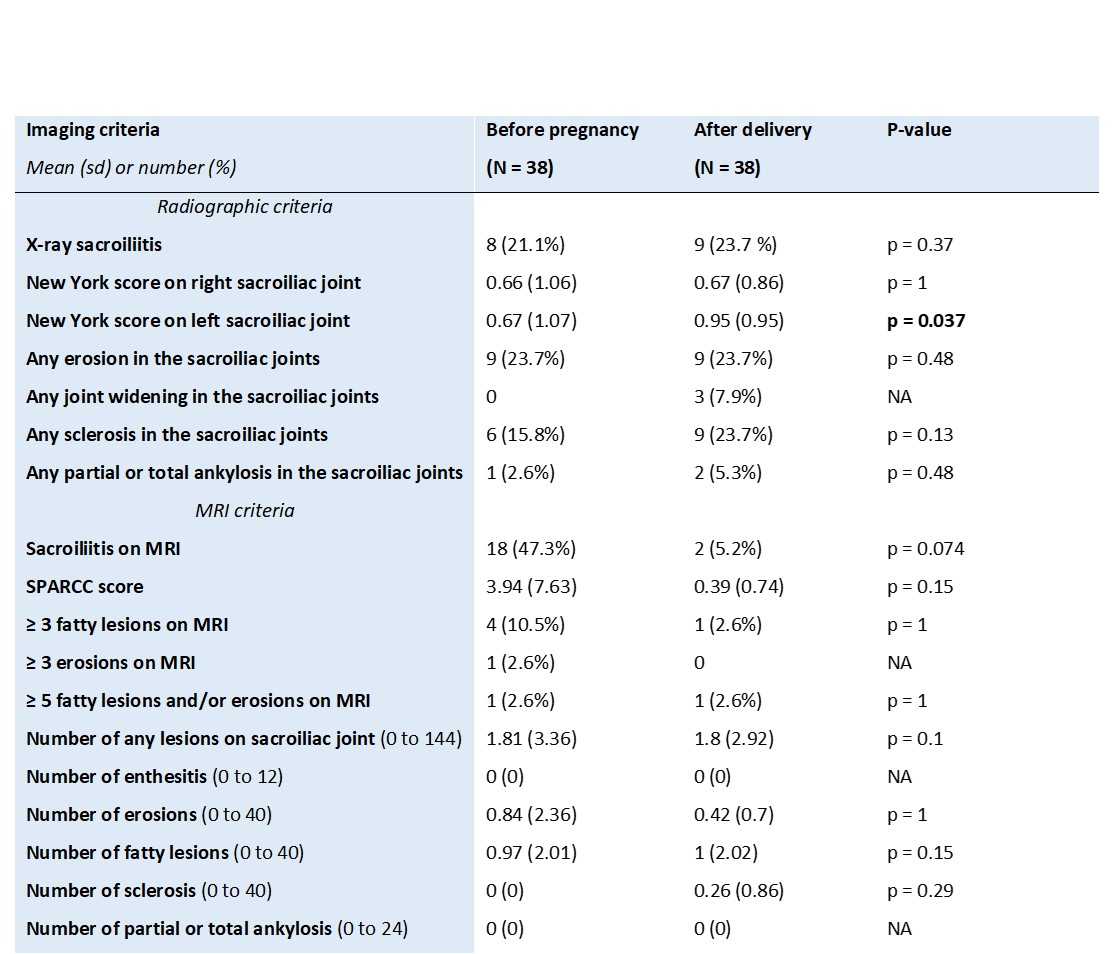
When focusing on incident pregnancies, these patients had more sacroiliitis on X-ray and MRI at baseline than patients nulligravidae at the end of follow-up and patients with past pregnancy, but had lower BASFI and ASDAS-CRP. Only left SIJ was statistically different after delivery, with mean scores of 0.67 and 0.95 before and after delivery (table 2). No impact of pregnancy on continuous imaging score was found with the different mixed models.
Conclusion: Pregnancy does not seem to aggravate imaging of axSpA women when comparing imaging according to the antecedent of pregnancy. Following axSpA patients who had first pregnancy showed mild increase of left sacroiliitis score on X-ray after delivery, but not enough to be considered as “worsening”.
Table 1: Imaging characteristics of women with axSpA according to antecedent of pregnancy at baseline, and statistical analysis with Student test or Chi-square (for continuous and binary variables, respectively).
Table 2: Imaging characteristics in women with axSpA who had first pregnancy during follow up, with description before/after delivery and paired-test with Mc Nemar of Student test (for binary and continuous variables, respectively).
E. Portier: None; M. Dougados: AbbVie, 2, 5, Bristol Myers Squibb, 2, 5, Eli Lilly, 2, 5, MSD, 2, 5, Novartis, 2, 5, Pfizer Inc, 2, 5, Roche, 2, 5, UCB, 2, 5; A. Ruyssen-Witrand: None; A. Molto: None.