University of Modena and Reggio Emilia, Italy Modena, Modena, Italy
Disclosure information not submitted.
Monia Maccaferri, Alessandra Pisciotta, Gianluca Carnevale, Carlo Salvarani and ELISA PIGNATTI, University of Modena and Reggio Emilia, Modena, Italy
Background/Purpose: Macrophages have been found to have a key role in Rheumatoid Arthritis. Depending on the microenvironment, macrophages exist in a dynamic functional state which could be mainly grouped in a pro-inflammatory state (M1 macrophages) and an anti-inflammatory state (M2 macrophages). In vitro, these conditions can approximately be reproduced by means of cytokines such as lipopolysaccharide (LPS) and IFNγ for M1 classically polarized macrophages or IL-4 and IL-13 for M2 alternatively polarized macrophages. Human dental pulp stem cells (hDPSCs) are adult stem cells which have been found to exert immunomodulatory functions both by cell-to-cell contact and in a paracrine way. The aim of our study was to assess the ability of hDPSCs to modulate the phenotype of human macrophages.
Methods: Peripheral blood mononuclear cells (PBMCs) were isolated from buffy coats by density-gradient centrifugation. PBMCs were differentiated to macrophages for 7 days in RPMI supplemented with M-CSF to obtain M0 macrophages. M0 macrophages were then polarized for 48 hours to M1 with LPS and IFNγ and to M2 macrophages with IL-4 and IL-13. hDPSCs were seeded at 1:1 ratio both directly on macrophages and into Transwell insert for indirect co-culture. Macrophages in direct co-culture with hDPSCs were separated with human anti CD14 micro beads. Protein expression was measured by Western Blot. Gene expression was assessed by RT-PCR.
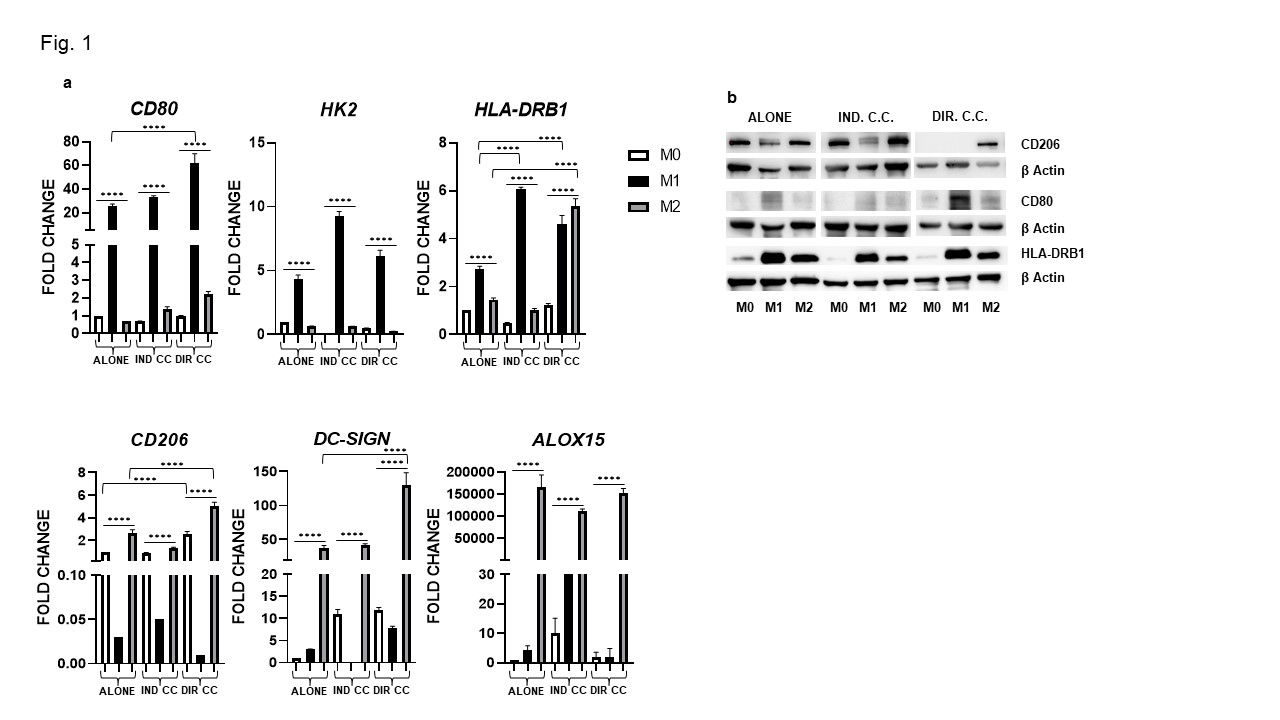
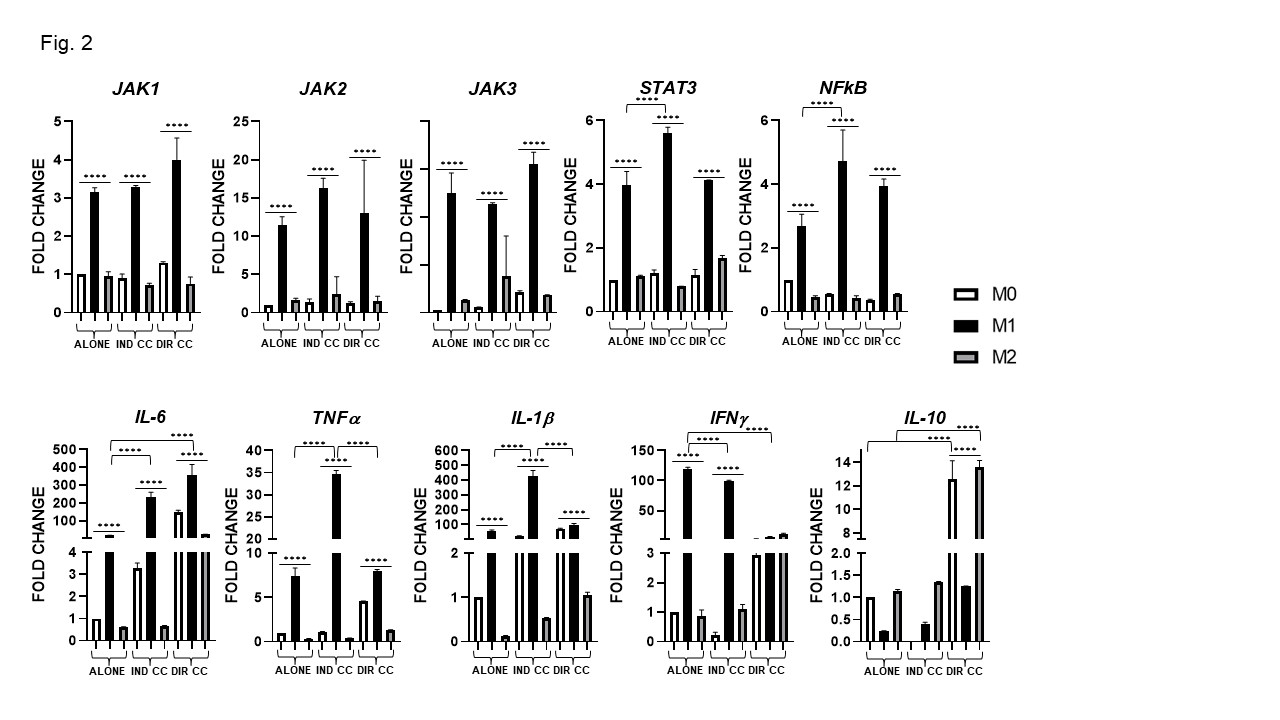
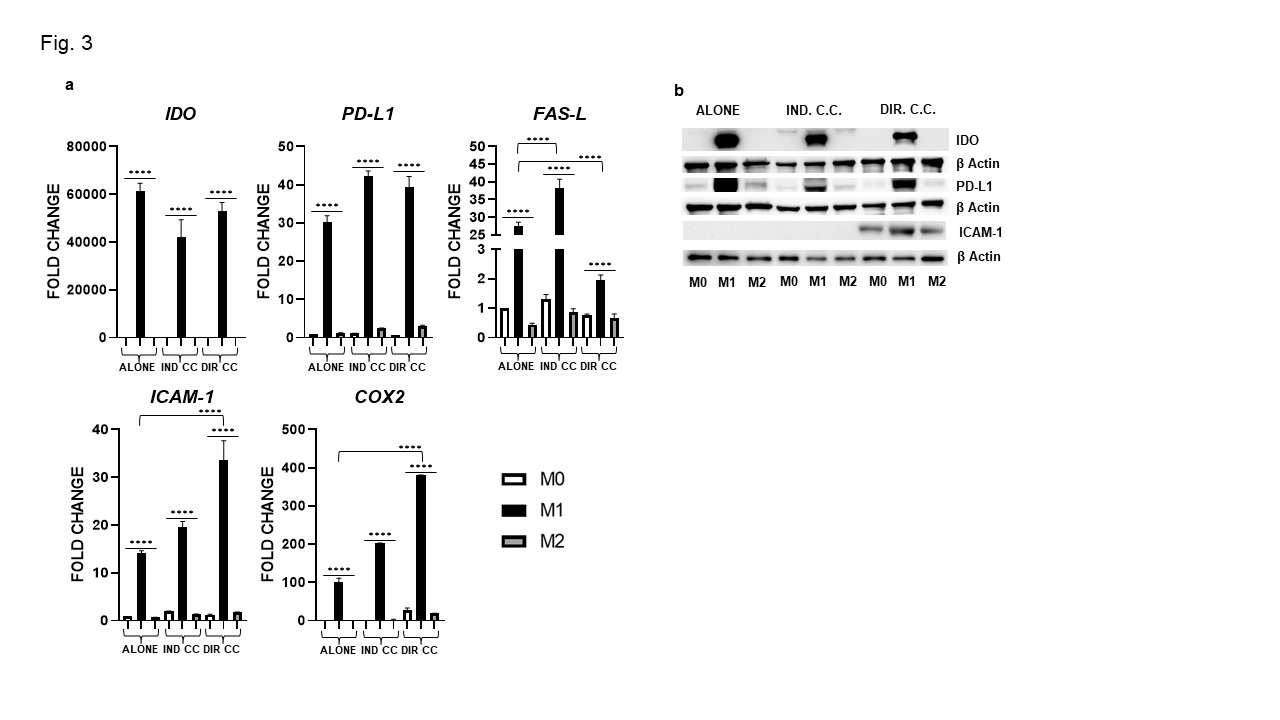
Results: Surface markers expression analysis showed that M1 macrophages were CD80+, HK2+, HLA-DRB1+(p < 0.0001). Following co-culture, CD80 and HLA-DRB1 gene expression was further increased (p < 0.0001) (Fig. 1a), data were also confirmed by protein expression (Fig. 1b). M1 macrophages showed elevated expression of the transcriptional regulators JAK-1, -2, -3,STAT3, NF-kB and of pro-inflammatory cytokines (IL-6, TNFα, IL-1β, IFNγ) levels (p < 0.0001) (Fig. 2). They also express elevated levels of the immune modulators IDO, PD-L1 and ICAM-1 confirmed by protein expression (Fig. 3a, -b) and, of Fas-L and COX2 (Fig. 3a). The indirect co-culture enhanced the expression of STAT3, NF-kB, IL-1β, IL-6, Fas-L and decreased IFNγ expression (p < 0.0001) (Fig. 2, 3). The direct co-culture increased IL-6,ICAM-1 and COX2 expression and diminished IFNγ and Fas-L expression (p < 0.0001) (Fig. 2, 3). M2 macrophages were CD206+, DC-SIGN+ and ALOX15+ and only the direct co-culture was able to enhance the HLA-DR, CD206, DC-SIGN and IL-10 expression (p < 0.0001) (Fig. 1, 2). The direct co-culture increased the expression of CD206 and IL-10 in M0 non-polarized macrophages too (p < 0.0001) (Fig. 1, 2).
Conclusion: The biological factors secreted by hDPSCs supported the macrophages response to inflammation activating the STAT3 and NF-kB pathways and, in contrast, enhancing the inhibitory membrane molecule FasL expression. The cell-to-cell contact was shown to be the best immunomodulatory way reducing the IFNγ expression in inflammatory condition. Further, in presence of anti-inflammatory cytokines, hDPSCs directly promoted the polarization of M0 macrophages towards M2 phenotype and enhanced IL-10 expression which is a key cytokine in limiting the host immune response.
Fig. 1. Macrophages markers expression. a) Relative mRNA expression. M0 macrophages alone is the control group used to normalize data (considered 1) expressed as fold change. ****p<0.0001. b) Representative western blot depicting proteins immune-probed. β-actin levels were used as loading control. Indirect co-culture (IND CC), direct co-culture (DIR CC).
Fig. 2. Transcriptional regulators and cytokines expression calculated as fold change. ****p<0.0001. Indirect co-culture (IND CC), direct co-culture (DIR CC).
Fig. 3. Immune-modulator expression. a) Relative mRNA expression as fold change. b) Representative western blot lanes. ****p<0.0001. Indirect co-culture (IND CC), direct co-culture (DIR CC).
M. Maccaferri: None; A. Pisciotta: None; G. Carnevale: None; C. Salvarani: None; E. PIGNATTI: None.