Session: Abstracts: Osteoarthritis II: Novel Insights from Observational Studies (2467–2472)
2467: Quadriceps Muscle Fat Composition but Not Muscle Energetics Is Associated with Knee Osteoarthritis: Initial Results from the Study of Muscle, Mobility, and Aging
University of California Hillsborough, CA, United States
Disclosure(s): Amgen: Consultant (Ongoing)
Giovanna Distefano1, Daniel Evans2, Peggy Cawthon2, John Lynch2, Thomas Link2, Philip Kramer3, Stephanie Harrison2, Bret Goodpaster4, Jane Cauley5, Theresa Mau2, Paul Coen4, Lauren Sparks4 and Nancy Lane6, 1AventisHealth, Orlando, FL, 2University of California San Francisco, San Francisco, CA, 3Wake Forest, Winston-Salem, NC, 4Aventis Health, Orlando, FL, 5University of Pittsburgh, Pittsburgh, PA, 6University of California, Hillsborough, CA
Background/Purpose: Osteoarthritis (OA) remains the most common cause of joint pain and disability with age, and to date, effective treatments to reduce pain and slow disease progression remain elusive. Nonpharmacologic therapies, including physical therapy and walking, are reported to be effective in reducing knee pain and maintaining function in subjects with knee OA (KOA). Deep phenotyping of the thigh muscle was performed in older adults from the Study of Muscle, Mobility, and Aging (SOMMA) with the goal of determining the relationship between measures of muscle health and KOA in older adults.
Methods: Men and women aged >70 yrs. recruited from two study sites (University of Pittsburgh and Wake Forest University) based on their ability to walk ¼ mile at >= 0.6m/s and perform study related activities. Muscle mass and composition were assessed by MRI of the thigh, and D3Cr muscle mass by D3-creatine dilution. Knee extensor leg power was assessed using a Keiser exercise machine. Muscle mitochondrial energetics were assessed by P31 MRS (ATPmax) and high resolution respirometry of permeabilized myofibers collected from a muscle biopsy of the vastus lateralis (Oxidative phosphorylation, OXPHOS). At one-year post-enrollment, knee x-rays and standardized knee pain assessments were completed, and knee OA was defined by Kellgren and Lawrence (KL) grade >= 2. Participants were grouped NoKOA, NoPain; NoKOA, Pain; KOA, NoPain, and KOA, Pain. Differences between groups were assessed by ANOVA with parametric post-hoc tests and associations between participants with knee OA and muscle variables were analyzed by linear regression adjusted for age, gender, study site/technician, and race.
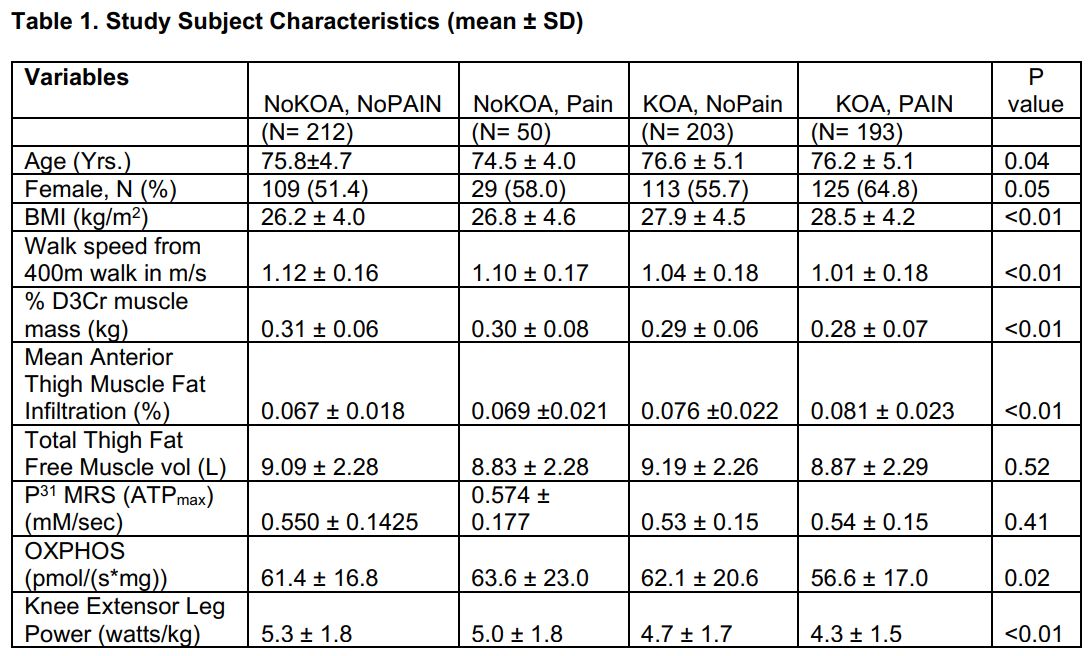
Results: This analysis was performed on 658 SOMMA participants who had knee x-rays obtained, with a mean age of 76.1 yrs. Subjects with KOA tended to be older, with more anterior intramuscular fat, lower knee extension leg power and lower mitochondrial energetics (Table 1). After adjustment for age, gender, race, BMI and study site, KOA with and without pain groups showed lower % functional muscle mass by D3Cr enrichment, lower knee extensor leg power, and greater anterior thigh intramuscular fat compared to the NoKOA, NoPain group (Table 2). No significant differences between groups were observed for the muscle mitochondrial energetics measures.
Conclusion: Older adults with KOA, with and without knee pain, have lower D3Cr muscle mass, lower knee extension leg power, similar mitochondrial function, and higher amounts of intramuscular fat than those without knee OA and without pain. The association of KOA with increased intramuscular fat is now under investigation.
G. Distefano: None; D. Evans: None; P. Cawthon: None; J. Lynch: None; T. Link: None; P. Kramer: None; S. Harrison: None; B. Goodpaster: None; J. Cauley: None; T. Mau: None; P. Coen: None; L. Sparks: None; N. Lane: None.




.jpg)