0673: Reporting of Race, Ethnicity, Sex, Gender, Socioeconomic Status and Representativeness of Race and Ethnicity in ANCA-associated Vasculitis Randomized Trials
National Referral Center for Rare Systemic Autoimmune Diseases Paris ( 75014 ), France
Disclosure information not submitted.
Michele Iudici1, Juan C. Rueda2 and Xavier Puéchal3, 1Division of Rheumatology, Department of Internal Medicine Specialties, Geneva University Hospitals, Geneva, Switzerland, 2Universidad de La Sabana, Chía, Colombia, Chia, Colombia, 3National Referral Center for Rare Systemic Autoimmune Diseases, Paris, France
Background/Purpose: To assess how and to what extent race, ethnicity, sex, gender and socioeconomic status of participants are reported in ANCA-associated vasculitis (AAV) randomized controlled trials (RCTs), and to estimate the representativeness of different ethnic/racial groups in AAV-RCTs.
Methods: We searched all published AAV-RCTs indexed in PubMed and Embase since 2000. We retrieved information on main features of RCTs published from 2000 to 2022 and recorded for each study whether participant race/ethnicity, socioeconomic status (SES) and sex/gender were reported; how ethnicity/race was defined and assigned; the number of patients included for each racial/ethnic group. Descriptive statistics was used to summarize the main study results.
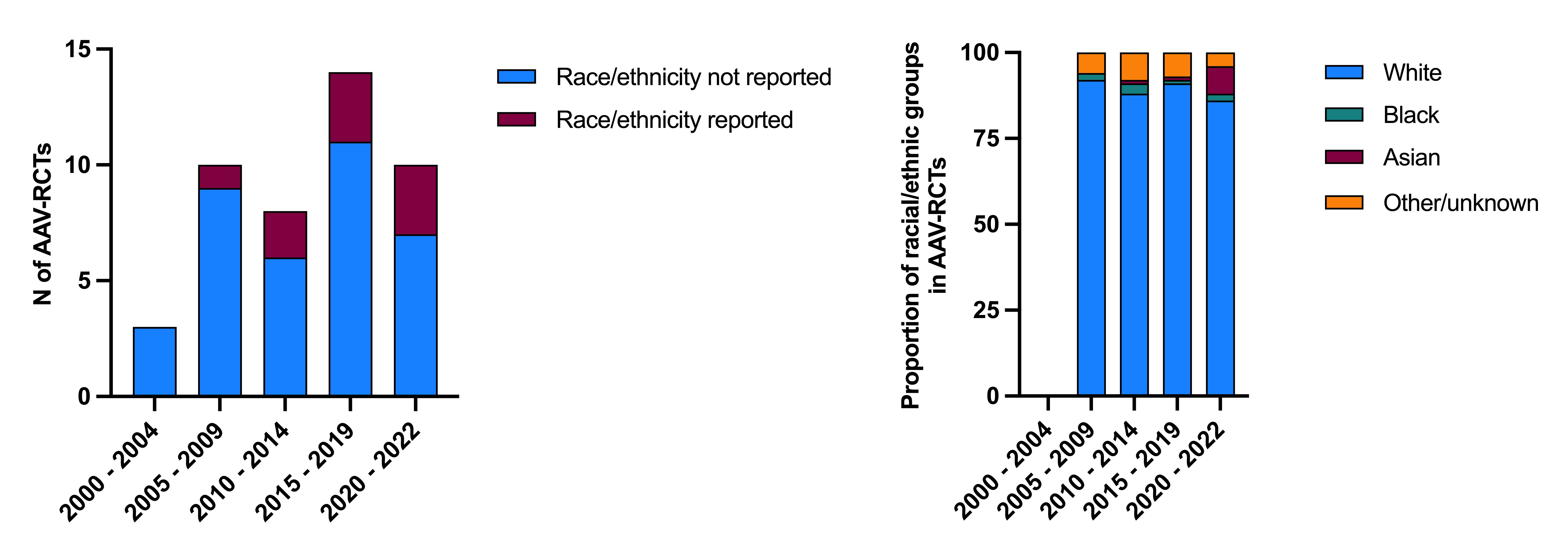
Results: We included 45 studies enrolling a total of 5053 patients (42% recruiting in more than one country), mostly published between 2011 - 2022 (62%), including patients with mainly granulomatosis with polyangiitis (GPA) or microscopic polyangiitis (MPA) (68%), and mainly investigating pharmacologic interventions (98%). Information on race/ethnicity was available in 9 (20%) studies, 7 of which published ≥ 2011, including a total of 1445 (28%) patients. Figure 1 (left panel) shows the number of studies reporting race/ethnicity over time. Sex and/or gender of participants was reported in all but one study, but in 33 (73%) studies the authors clearly specified whether they reported the sex or the gender. In univariate analysis, we found a better reporting of race/ethnicity for larger studies including patients from different continents, funded by industry, and being published in higher impact factor journals. In studies where race/ethnicity was reported, White patients were the most represented (90%), followed by Asian (3%) and African American (2%). Figure 1 (right panel)presents temporal trends in the proportion of included participants across racial/ethnic groups in the overall sample of studies. Studies never reported the reasons for collecting race/ethnicity or subgroup analyses focusing on race/ethnicity. Only one study provided the definitions used to identify different patient's origin. Only one paper reported patient SES.
Conclusion: Reporting of race/ethnicity and socioeconomic status deserves to be improved in AAV-RCTs. The non-White patients are underrepresented in AAV-RCTs reporting race/ethnicity of participants.
M. Iudici: Boehringer-Ingelheim, 1; J. Rueda: None; X. Puéchal: None.