Wils Nielsen1, Vibeke Strand2, Lee Simon3, Maya Desai4, Ioannis Parodis5, Alfred Kim6, Daniel Wallace7, Yashaar Chaichian8, Sandra Navarra9, Cynthia Aranow10, Meggan MacKay10, Kimberly Trotter11, Oshrat Tayer-Shifman12, Ali Duarte-Garcia13, Lai-Shan Tam14, Manuel Ugarte-Gil15, Guillermo Pons-Estel16, John Reynolds17, Mandana Nikpour18, Danae Papachristos19, Alberta Hoi20, Alison Hendry21, Juanita Romero-Diaz22, Rosalind Ramsey-Goldman23, Hanan Alrayes24, Ibrahim Almaghlouth25, Aarabi Thayaparan26, Carolina Munoz-Grajales27, Aaron Howe28, Behdin Nowrouzi-Kia28, Melanie Anderson29, Dennisse Bonilla29, Julian Thumboo30, Marta Mosca31, Martin Aringer32, Sindhu Johnson33, Aaron Drucker34, Eric Morand35, Ian Bruce36 and Zahi Touma28, 1University of Toronto, Markham, ON, Canada, 2Stanford University, Portola Valley, CA, 3SDG LLC, West Newton, MA, 4OCAD University, Toronto, ON, Canada, 5Karolinska Institutet, Stockholm, Sweden, 6Washington University School of Medicine, St. Louis, MO, 7Cedars-Sinai/David Geffen School of Medicine at UCLA, Los Angeles, CA, 8Stanford University, San Mateo, CA, 9University of Santo Tomas Hospital, Joint and Bone Center, Manila, Philippines, 10Feinstein Institutes for Medical Research, Manhasset, NY, 11University of Chicago, Chicago, IL, 12Meir Medical Center, Raanana, Israel, 13Mayo Clinic, Rochester, MN, 14The Chinese University of Hong Kong, New Territories, China, 15Universidad Cientifica del Sur, Lima, Peru, 16RELESSAR, Rosario, Argentina, 17University of Birmingham, Birmingham, United Kingdom, 18The University of Melbourne at St. Vincent’s Hospital Melbourne, Departments of Medicine and Rheumatology, Melbourne, Australia, 19Mater Hospital, Brisbane, Australia, 20Monash University, Department of Medicine, Sub-faculty of Clinical and Molecular Medicine, Melbourne, Australia, 21Te Whatu Ora, Counties Manukau District, Middlemore Hospital, Auckland, New Zealand, 22Instituto Nacional de Ciencias Medicas y Nutricion Salvador Zubiran, Mexico City, Mexico, 23Northwestern University, Chicago, IL, 24Riyadh Military - Prince Soltan Military Medical City ( PSMMC ) - Olaya, Riyadh, Saudi Arabia, 25King Saud University, Riyadh, Saudi Arabia, 26Schroeder Arthritis Institute, Krembil Research Institute, Markham, ON, Canada, 27UHN/TWH, Toronto, ON, Canada, 28University of Toronto, Toronto, ON, Canada, 29University Health Network, Toronto, ON, Canada, 30Singapore General Hospital; Duke-NUS Medical School, Singapore, Singapore, 31Rheumatology Unit, Department of Clinical and Experimental Medicine, University of Pisa, Pisa, Italy, 32Faculty of Medicine TU Dresden, Dresden, Germany, 33Institute of Health Policy, Management, and Evaluation, University of Toronto, Toronto, ON, Canada, 34Women's College Hospital, Toronto, ON, Canada, 35Monash University, Centre for Inflammatory Diseases, Melbourne, Australia, 36University of Manchester, Manchester, United Kingdom
Background/Purpose: We established the OMERACT SLE Working Group in 2021 which includes over 150 members representing over 25 countries and 5 continents to develop a new SLE Core Domain Set (CDS) and measurement instrument set. A CDS is essential for standardizing the measurement and reporting of domains in clinical trials and longitudinal studies in SLE. Domains in a CDS are selected from a candidate domain list through consensus voting exercises with stakeholders including patients, clinicians, researchers, pharmaceutical representatives, and others. The first CDS development stage is generating a preliminary list of candidate domains. To inform the development of the new OMERACT SLE CDS, we have conducted a scoping literature review of systematic reviews and clinical trials of SLE, and focus groups with SLE patients about living with SLE.
Methods: Scoping Review: We searched 5 databases (Medline, Embase, Cochrane, CINALH, PsycINFO) since 2010 and used Covidence for article screening. 3 reviewers performed an agreement test on the first 100 articles for title and abstract screening with a 98% agreement. Due to the large volume of studies, the 1st screening of title and abstract was conducted by a single reviewer. A 2nd agreement test on 100 articles was performed for full-text screening with the same reviewers with a 99% agreement. The 2nd screening of full-texts and data extraction of domains required 2 reviewers per article. Focus Groups: We developed an interview guide of 11 open-ended questions asking about the pathophysiological manifestations and life impact of SLE. Patients were recruited by the University of Toronto from around the world representing 5 continents and 13 countries. Six focus groups were held virtually ranging from 3 to 10 participants per group. Transcripts have been developed and thematically coded using an open coding framework. Advisory Group: An advisory group was established with members from the OMERACT SLE Working Group Steering Committee, Patient Research Partners, and additional SLE Expert Stakeholders. This group reviewed all domains and themes and sorted them into domains.
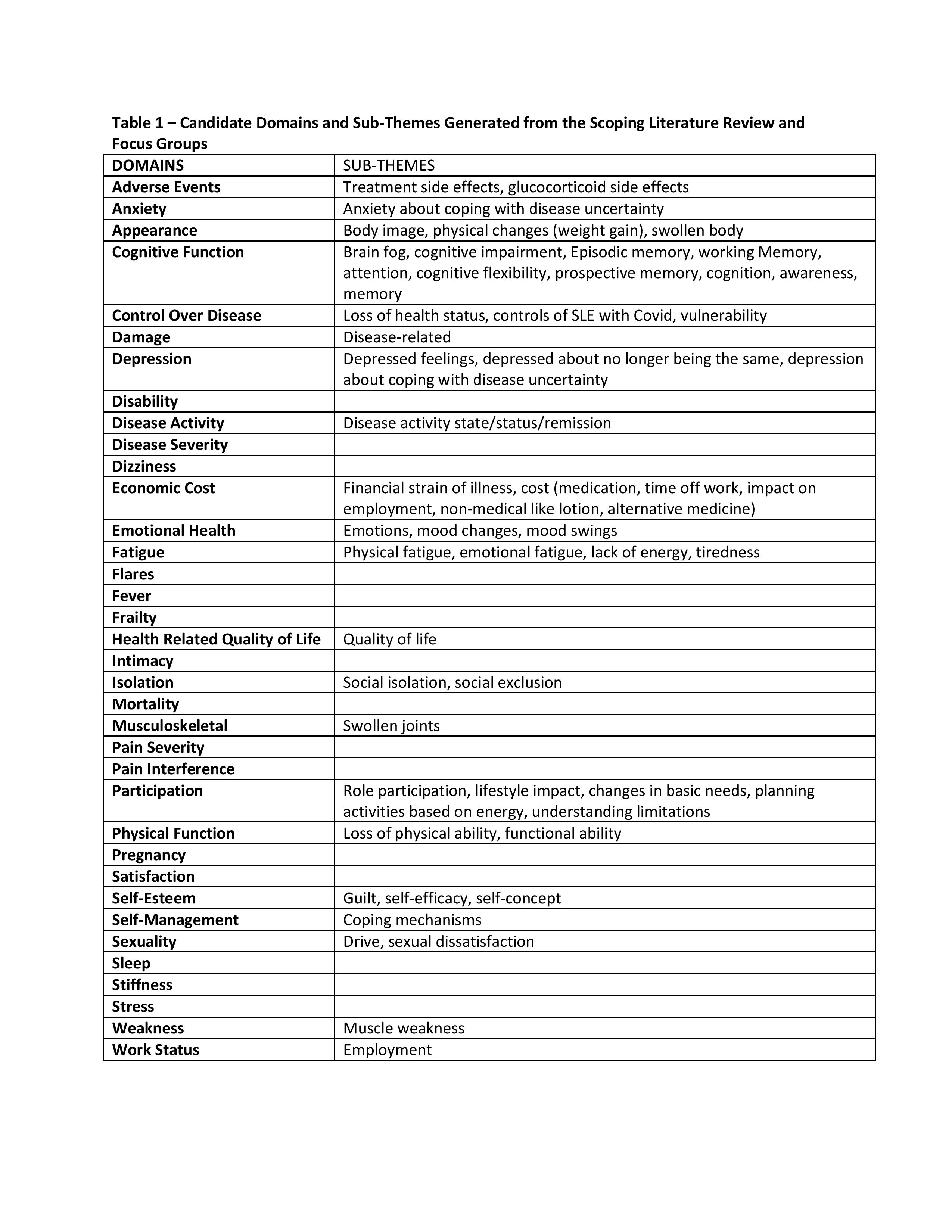
Results: The literature search yielded 4113 articles. The 1st screening reduced the number of articles to 1421. The 2nd screening reduced the number of articles to 597. The scoping review and focus group transcripts yielded over 200 themes/domains. Duplicate and related themes/domains were grouped, and contextual factors were removed yielding a preliminary total of 36 domains (Table 1) which included domains such as disease activity, cognitive function, sleep, fatigue, anxiety, depression, stress, participation, pain interference, intimacy, and more.
Conclusion: Many candidate domains have been identified through the scoping literature review and focus group interviews. Further work is in process to finalize the list of the candidate domains to continue with a 4 round Delphi consensus voting exercise to achieve consensus on the new SLE CDS. The future goal for the SLE OMERACT Working Group is the instruments selection for each domain of the new CDS and appraisal of instruments measurement properties.