Aaron Howe1, Anson Li2, Kevon Jules2, Jeremy Tan2, Malek Sadek2, Mahta Kakvan3, Vijay Chattu1, Ali Bani-Fatemi1, Dennisse Bonilla4, Wils Nielsen5, Nicole Anderson6, J. Antonio Avina-Zubieta7, Mary Fox8, William Shaw9, Derek Haaland10, Janet Pope11, Paul R. Fortin12, Kathleen Bingham4, Nathalie Rozenbojm4, Christine Peschken13, Jiandong Su4, Jennifer Reynolds14, Catherine Ivory15, Dafna Gladman16, Murray Urowitz17, Francisco Sanchez-Guerrero18, Lily Lim13, Stephanie Keeling19, Ana Soberanis1, Patti Katz20, Zahi Touma1 and Behdin Nowrouzi-Kia1, 1University of Toronto, Toronto, ON, Canada, 2University of Toronto, Restore Lab, Toronto, ON, Canada, 3University Health Network, University of Toronto, Toronto, ON, Canada, 4University Health Network, Toronto, ON, Canada, 5University of Toronto, Markham, ON, Canada, 6Schroeder Arthritis Institute, Krembil Research Institute, University Health Network and University of Toronto, Toronto, ON, Canada, 7Arthritis Research Canada, Vancouver, BC, Canada, 8York University, Toronto, ON, Canada, 9University of Connecticut School of Medicine, Farmington, CT, 10The Waterside Clinic, Oro Medonte, ON, Canada, 11University of Western Ontario, London, ON, Canada, 12Centre ARThrite - CHU de Québec - Université Laval, Quebec City, QC, Canada, 13University of Manitoba, Winnipeg, MB, Canada, 14University of British Columbia, Vancouver, BC, Canada, 15The Ottawa Hospital Research Institute, Ottawa, ON, Canada, 16Schroeder Arthritis Institute, Krembil Research Institute, Toronto Western Hospital, Department of Medicine, University of Toronto, Toronto, ON, Canada, 17Schroeder Arthritis Institute, Krembil Research Institute; University of Toronto Lupus Clinic; Division of Rheumatology, Toronto, ON, Canada, 18University Health Network/Sinai Health system, Toronto, ON, Canada, 19University of Alberta, Edmonton, AB, Canada, 20University of California San Francisco, San Rafael, CA
Background/Purpose: Work participation meaningfully influences mental wellbeing, health-related quality of life, and disease-related outcomes in individuals with systematic lupus erythematosus (SLE). Previous studies estimate that 20-50% of SLE patients experience some form of work disability (WD) yet there is limited understanding of the integrative effects of the psychosocial and workplace factors associated with WD. The objective of this study was to identify psychosocial and workplace factors associated with WD to create an SLE-related functional profile that is grounded in a WD prevention framework.
Methods: SLE patients (n=28) were purposively recruited from multiple medical centers across Canada. Guided by the WD prevention framework, semi-structured interviews were conducted with patients to explore their perspectives of factors associated with WD. The guide contained questions corresponding to the framework's proposition that disability in the workplace is not only due to the workers' characteristics but also due to environmental factors. Interview data were transcribed verbatim. Thematic analysis was utilized to analyze the data.
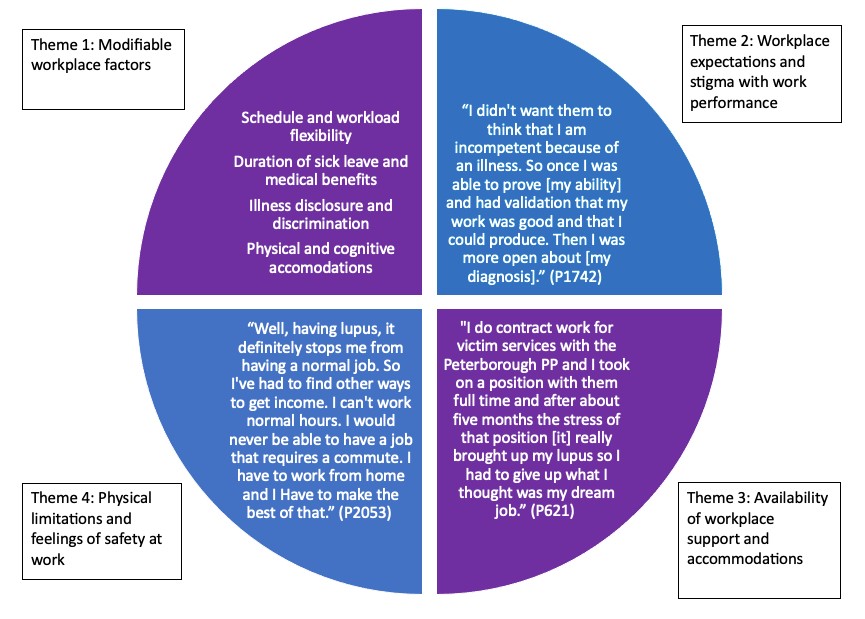
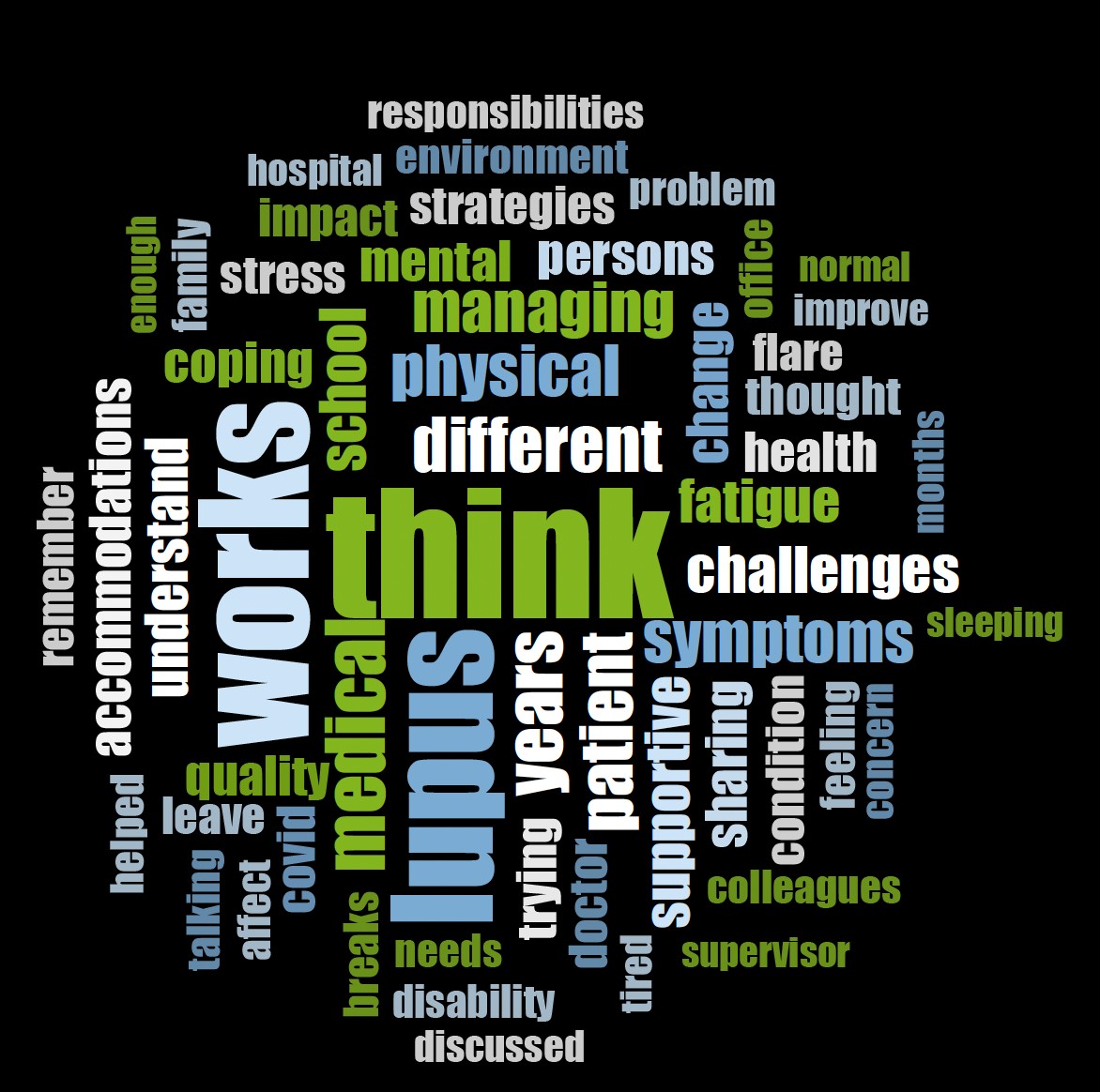
Results: Four themes emerged from the data: a) modifiable workplace factors, b) workplace expectations and stigma with work performance, c) availability of workplace support and accommodations, d) physical limitations and feelings of safety at work (Figure 1). Neurocognitive symptoms, fatigue, and physical limitations were frequently reported as factors associated with WD in SLE. Participants reported that participation in work increased their personal control, and reduced their physical and mental demands were more desirable and which in turn, subjectively prevented WD (Figure 2).
Conclusion: WD in SLE necessitates the recognition of the dynamic symptom fluctuations and multidimensionality of the disease, in the context of its relationship to work. Future studies should examine the psychosocial and workplace factors identified to establish a goal-oriented preventative framework that could improve WD outcomes in individuals with SLE.
Figure 1. Thematic analysis diagram
Figure 2. Word frequency diagram
A. Howe: None; A. Li: None; K. Jules: None; J. Tan: None; M. Sadek: None; M. Kakvan: None; V. Chattu: None; A. Bani-Fatemi: None; D. Bonilla: None; W. Nielsen: None; N. Anderson: None; J. Avina-Zubieta: None; M. Fox: None; W. Shaw: None; D. Haaland: None; J. Pope: AbbVie, 1, 2; P. Fortin: AbbVie, 1, AstraZeneca, 1, 6, GlaxoSmithKlein(GSK), 1, 6, Roche-Genentech, 1; K. Bingham: None; N. Rozenbojm: None; C. Peschken: AstraZeneca, 2, 5, GSK, 2, 5, Roche, 1, 2; J. Su: None; J. Reynolds: AbbVie/Abbott, 6, AstraZeneca, 6, GlaxoSmithKlein(GSK), 6, sandoz, 6; C. Ivory: None; D. Gladman: AbbVie, 2, 5, Amgen, 2, 5, Bristol Myers Squibb, 2, Celgene, 2, 5, Eli Lilly, 2, 5, Galapagos, 2, Gilead Sciences, 2, Janssen, 2, 5, Novartis, 2, 5, Pfizer Inc, 2, 5, UCB, 2, 5; M. Urowitz: None; F. Sanchez-Guerrero: None; L. Lim: Pfizer, 6; S. Keeling: AbbVie/Abbott, 1, 6, AstraZeneca, 1, 6, Bristol-Myers Squibb(BMS), 1, 6, GlaxoSmithKlein(GSK), 1, 6, Roche, 1, 6, UCB, 1, 6; A. Soberanis: None; P. Katz: None; Z. Touma: AstraZeneca, 2, GSK, 2; B. Nowrouzi-Kia: None.



.png "Zahi Touma, MD, PhD photo")