University of Wisconsin Madison, WI, United States
Disclosure(s): No financial relationships with ineligible companies to disclose
Sarah Donohue, Tiffany Lin and Justin Levinson, University of Wisconsin, Madison, WI
Background/Purpose: Transitions in medical education, such as the matriculation from residency to fellowship, can be a challenging experience with increased knowledge expectations in new clinical settings. Despite the growing number of transition courses, or "bootcamps," there remains a paucity of medical education research, a leaning towards virtual programs, and no published orientation curricula for subspecialized training in rheumatology. We compared the effect of a near-peer rheumatology fellowship bootcamp on new fellows' self-assessments before, after, and 6 months following our intervention along with fellows' clinical knowledge exam scores and performance evaluations by faculty.
Methods: We designed a 3-day intensive, interactive, multi-modality curriculum that included near-peer senior fellow led introductory sessions, workspace tour, and workflow workshops. In addition, incoming fellows were exposed to hands-on SIM center physical exam teaching skills, MSK ultrasound introduction, injection teaching, and disease specific didactic sessions. The 2 junior rheumatology fellows were then assessed with a pre-, post-, and 6-month follow-up 46 question survey. Rheumatology faculty completed a 20-question survey comparing consecutive year fellows who did not complete a bootcamp to those who did. 10 clinical knowledge questions on basic concepts in rheumatology were administered to the fellows with each survey.
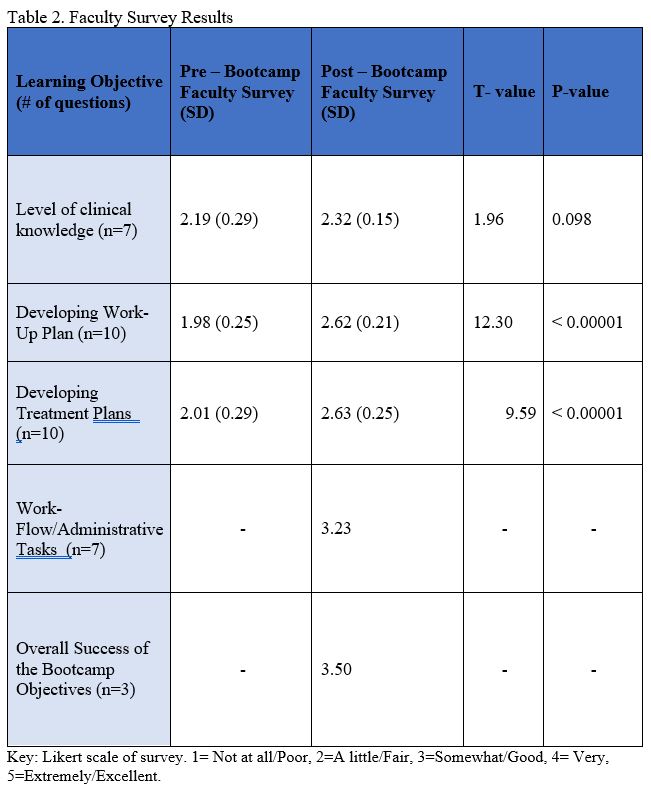
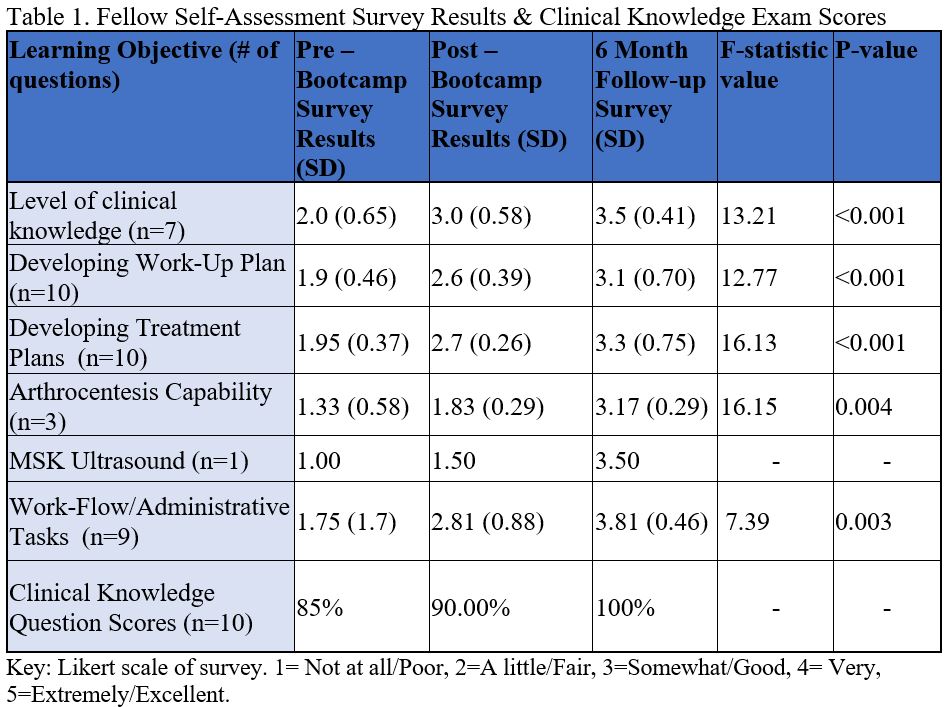
Results: With 46 survey questions grouped into learning objectives, we compared self-assessed comfort in: Level of clinical knowledge (n=7), Developing work-up plans (n=10), Developing treatment plans (n=10), Arthrocentesis capability (n=3), MSK ultrasound (n=1), and Workflow/administrative tasks (n=9; Table 1). We found that the bootcamp increased fellow level of confidence in all proposed learning objectives, and improvement continued at the 6-month follow-up retention of knowledge survey. The pre-bootcamp clinical knowledge mean exam score was 85%, improved to 90% on the post-bootcamp exam, and ultimately 100% correct at the 6 month follow up. Post intervention, the faculty survey discovered that our junior fellows were better equipped to develop a work-up plan (p< 0.00001) and treatment plan (p< 0.00001; Table 2). Faculty assessed the success in introducing high yield concepts between "good" and "very" with a score of 3.4 on a 5-point Likert scale. A secondary objective of comparing the creation of working relationships between faculty and new fellows was graded as 3.7.
Conclusion: This innovative University of Wisconsin rheumatology fellowship bootcamp represents the first published iteration for a near-peer led rheumatology curriculum. Distinctively, this curriculum included simulation center actors, a hands-on course on arthrocentesis and dedicated senior fellow led clinical setting workshops and tour. The fellow-led teaching model further consolidates the knowledge in senior fellows. Future directions include expansion of the bootcamp to prospectively collect baseline data and increase the sample size.
S. Donohue: None; T. Lin: None; J. Levinson: None.