Session: (1977–1995) Osteoarthritis – Clinical Poster III
1985: Preliminary Results for the Total Knee Replacement Coaching Program for Patients Preparing to Undergo Total Knee Arthroplasty, a Pilot Randomized Trial
Weill Cornell Medicine New York, NY, United States
Disclosure information not submitted.
Noelia Hernandez1, Yuliana Dominguez Paez2, Assem Jabri2, Mackenzie Brown2, Geyanne Lui3, Wai-Kwong Hui4, Michael Parks4, Alejandro Gonzalez Della Valle4, Fred Cushner4, Peter Sculco4, Thomas Sculco4, Mathias Bostrom4, Alejandro Leali4, Jason Blevins4, Jose Rodriguez4, Gwo-Chin Lee4, Lisa Mandl5, Susan Goodman4, Samprit Banerjee2, Monika Safford6 and Iris Navarro-Millán7, 1Weill Cornell Medicine, The Bronx, NY, 2Weill Cornell Medicine, New York, NY, 3New York Institute of Technology, New York, NY, 4Hospital for Special Surgery, New York, NY, 5Hospital for Special Surgery, Weill Cornell Medicine, New York, NY, 6WCM Department of Medicine, New York, NY, 7Weill Cornell Medicine, Hospital for Special Surgery, New York, NY
Background/Purpose: Up to 30% of patients with primary knee osteoarthritis (KOA) who have undergone Total Knee Replacement (TKR) continue to experience knee pain after surgery.High levels of anxiety and/or depression before TKR have been identified as predictors of post-TKR painand are barriers to engaging in post-TKR rehabilitation. The Moving Well is a pre- and post-TKR intervention thatcombinesprinciples of cognitive behavioral therapy (CBT) and home exercisesalongside a peer coach with the goal of reducing anxiety, depression, and knee pain post-TKR.A peer coach is a person with KOA who had undergone TKR and is guiding another person with KOA in the Moving Well interventionto prepare and recover from TKR. The goal of this abstract is to present the preliminary results of this pilot study regardingthe effectiveness and feasibility of Moving Well.
Methods: We included patients with KOA scheduled for TKR 8 weeks in advance between 50-89 years, had access to a computer, internet, and spoke English. Exclusion criteria were prior joint replacement surgery,unable to exercise, or anyrheumatic diseases. Participants were randomized to either Moving Well intervention or Staying Well attention control arm. Each group received weekly 1-hour phone sessions, 7 sessions pre-TKR and 5 sessions post-TKR. The Staying Well arm covered topics on nutrition and preventive medicine anddid not receive information on TKR, exercise, or CBT principles. We used one sided t-test to determine differences in mean Generalized Anxiety Disorder (GAD)-7, Patient Health Questionnaire (PHQ)-8 scores and mean changes in Knee Injury Osteoarthritis Outcome Score (KOOS)scoresbetween arms and between baseline (8 weeks pre-TKR) and 6 weeks after TKR.
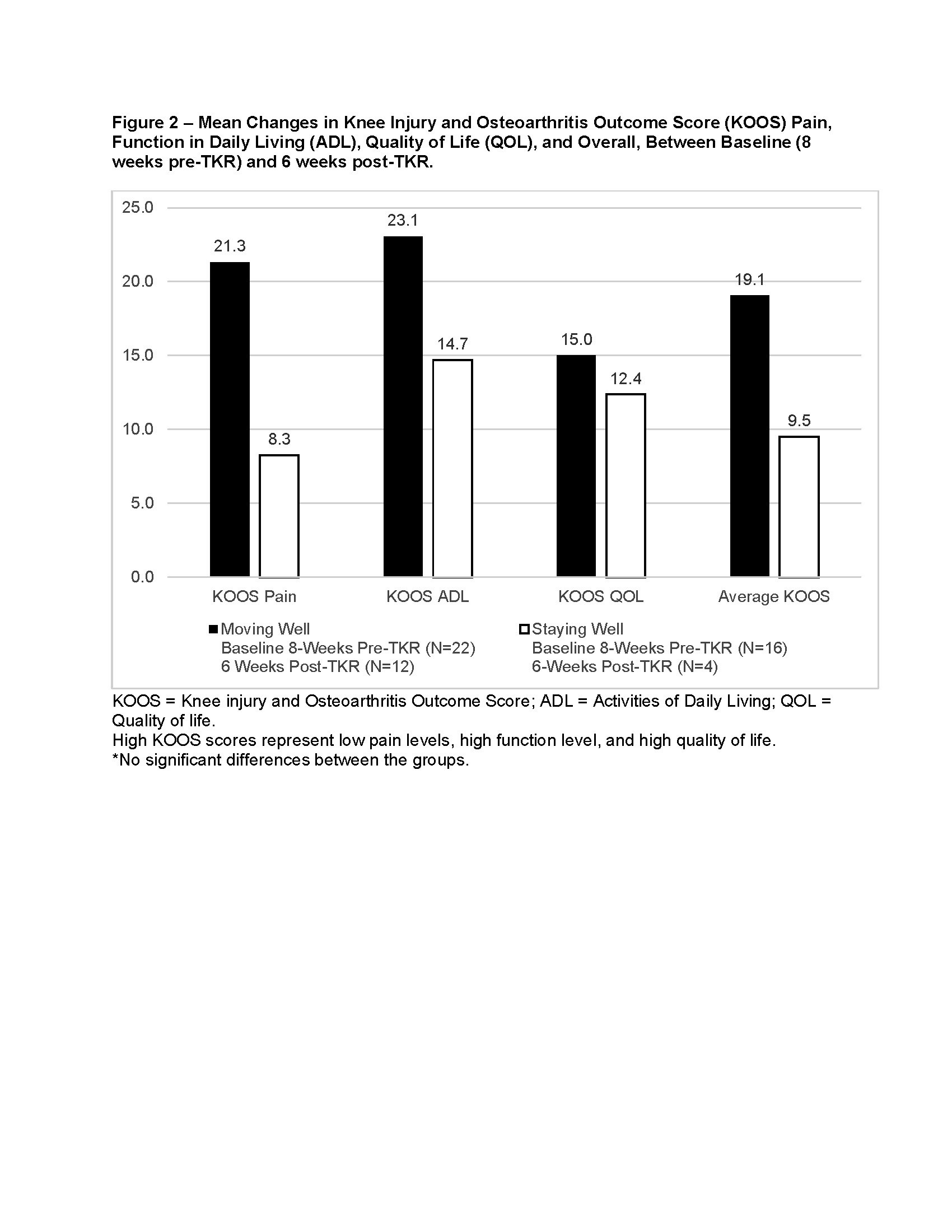
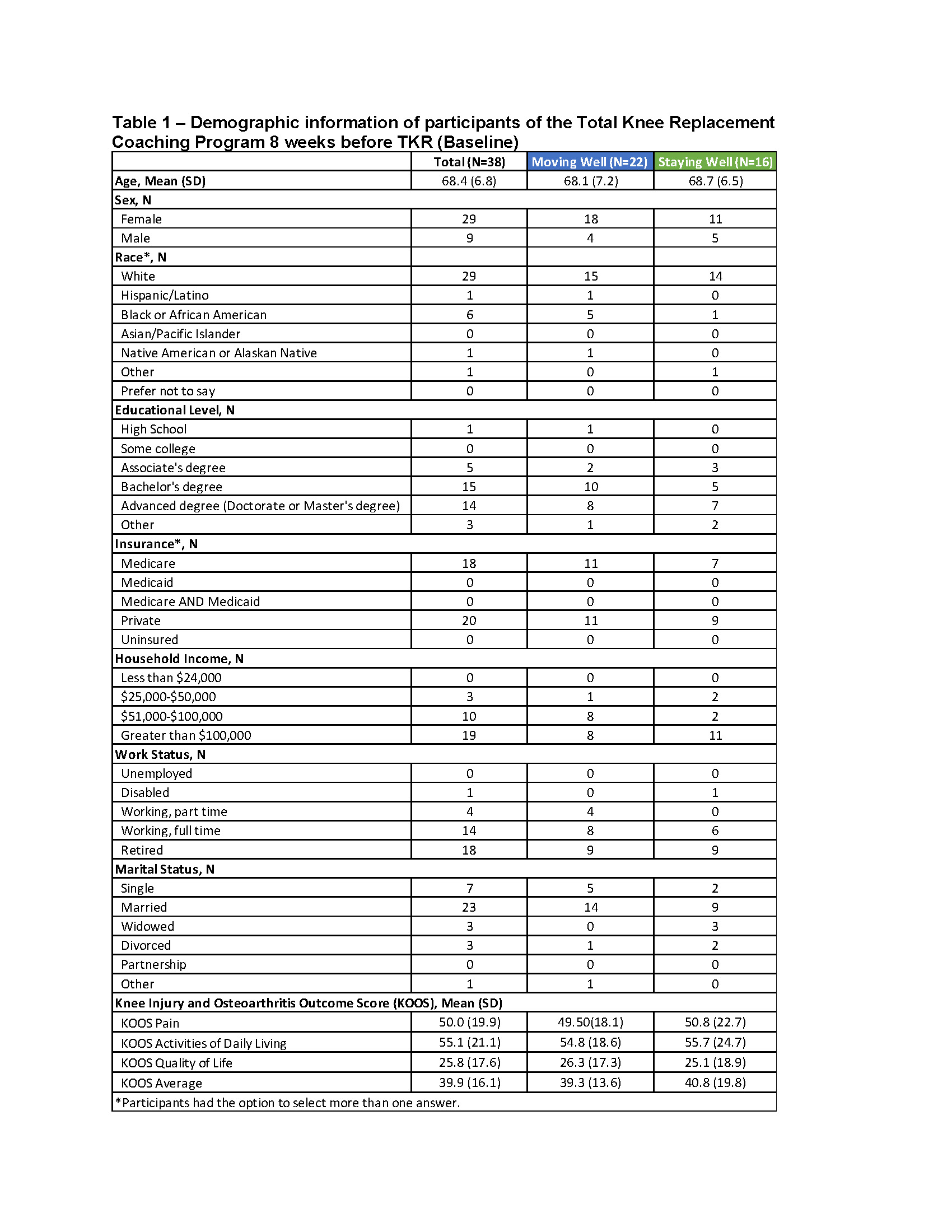
Results: Thereare 38 participants enrolled out of a target of 74 individuals for this pilot, with 22 in the Moving Well arm and 16 in the Staying Well arm. The meanage of participants is 68 years, and the population is mostly white and highly educated (Table 1). While there was no significant differencein depression (PHQ-8) or anxiety (GAD-7)scoresbetween arms (Figure 1), participants in the Moving Well program experienceda large improvement in KOOS scores 6-weeks post-TKR (Figure 2). None of the values were significant given the small sample. No participant from Moving Well dropped out while 3 dropped out from Staying Well, which suggests that the intervention is feasible and engaging for completion.
Conclusion: There were no significant changes in depression or anxiety levels between Moving Well and control groups. However, the Moving Well group demonstrated a noteworthy improvement in KOOS scorespost-TKR. These findings emphasize the potential benefits of a holistic approach in managing the challenges faced by KOA patients undergoing TKR, highlighting the importance of incorporating psychological support and exercise programs into pre- and post-operative rehabilitation protocols. Ongoing efforts are focused recruiting the 74 patients that are part of this intervention and determiningthelong-term effects (1-year post-TKR data) of the Moving Well intervention in reducing post-TKR pain.
N. Hernandez: None; Y. Dominguez Paez: None; A. Jabri: None; M. Brown: None; G. Lui: None; W. Hui: None; M. Parks: None; A. Gonzalez Della Valle: None; F. Cushner: None; P. Sculco: DePuy Synthes, 2, EOS Imaging, 2, Intellijoint Surgical, 2, 5, Lima Corporate, 2, Zimmer Biomet, 2, 5; T. Sculco: None; M. Bostrom: None; A. Leali: None; J. Blevins: None; J. Rodriguez: None; G. Lee: None; L. Mandl: Annals of Internal Medicine, 12, Associate Editor, Regeneron Pharmaceuticals, 5, Up-to-Date, 9; S. Goodman: NIH, 5, Novartis, 5; S. Banerjee: None; M. Safford: None; I. Navarro-Millán: None.



.jpg)