Seoul National University Hospital Seoul, South Korea
Disclosure information not submitted.
Ji In Jung1, Jun Won Park2, Song Jihun3, Seulggie Choi2, Sun Jae Park3, Sang Min Park2 and Eun Young Lee4, 1Division of Rheumatology, Department of Internal Medicine, Seoul National University Hospital, Seoul, South Korea, 2Seoul National University Hospital, Seoul, South Korea, 3Seoul National University Graduate School, Seoul, South Korea, 4Seoul National University College of Medicine, Seoul, South Korea
Background/Purpose: Previous studies on AAV have shown that the epidemiology and clinical features of GPA and MPA differ among countries. Considering their high mortality and morbidity, establishing a national epidemiology for GPA and MPA is necessary for physicians and healthcare systems to estimate the impact and burden of AAV. In this study, we investigated the epidemiological features of granulomatosis with polyangiitis (GPA) and microscopic polyangiitis (MPA) in South Korea.
Methods: We identified index cases of GPA and MPA using the 2010-2018 Korean National Health Insurance Service database and Rare Intractable Disease registry for the entire Korean population. Each disease's incidence and prevalence rates and trends over time were analysed. To assess the impact of disease on morbidity and mortality, a comparator group indicating the general population was established using nearest neighbourhood matching by age, sex, income, and comorbidity index, at a 5:1 ratio. Morbidity outcomes included the initiation of renal replacement therapy and admission to the intensive care unit (ICU).
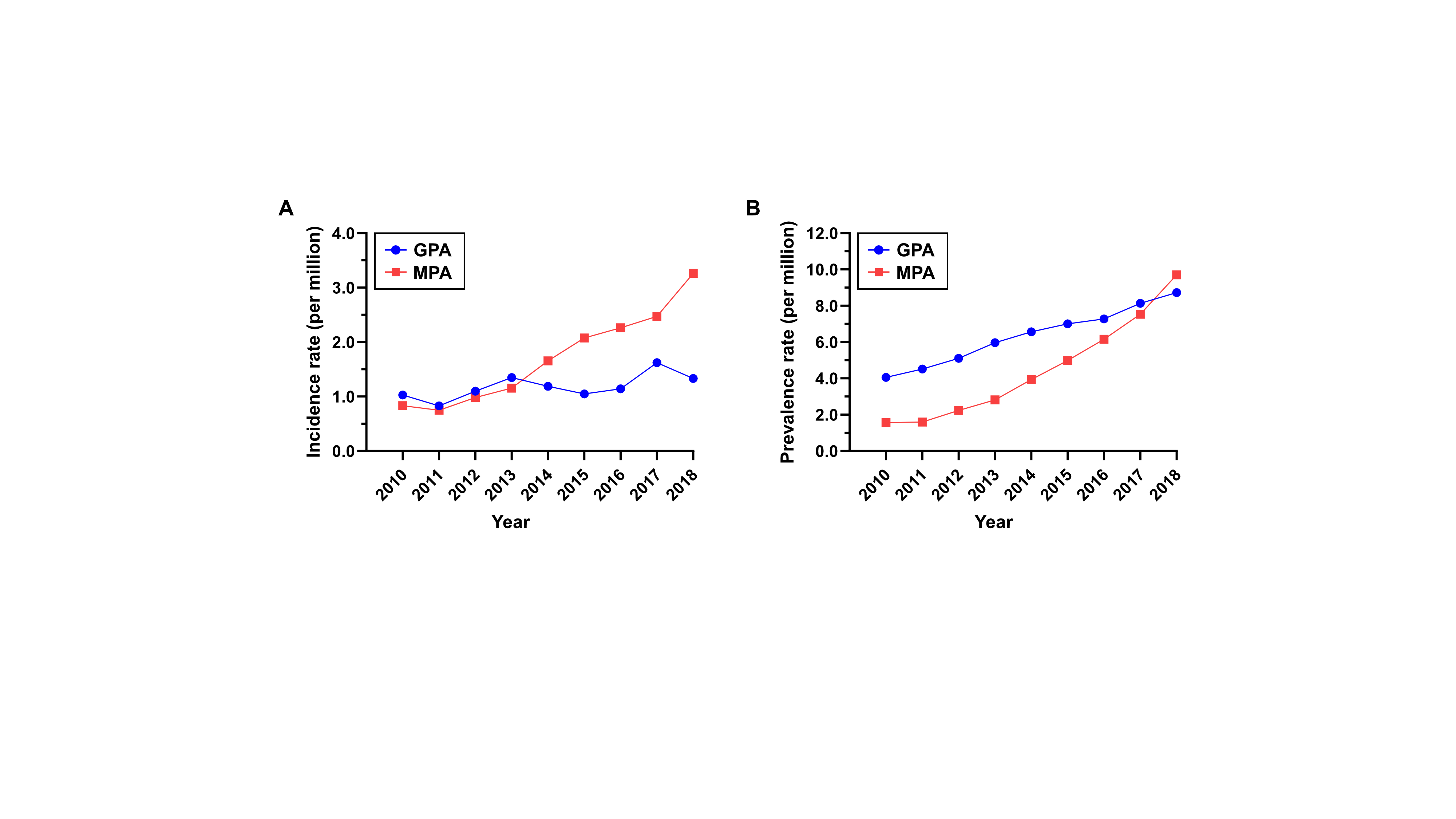
Results: A total of 546 and 795 patients with GPA and MPA, respectively, were identified. The incidence rates of both diseases increased with age, and the peak incidence rate was observed in patients aged > 70 years. GPA and MPA showed different trends in incidence rates over time. In 2010, the annual incidence rates (per million) of GPA and MPA were 1.03 and 0.83, respectively. The incidence of MPA has continuously increased over time and increased to 3.26 in 2018. In contrast, the annual incidence of GPA did not significantly change during the observation period and was 1.33 in 2018 (Figure 1).
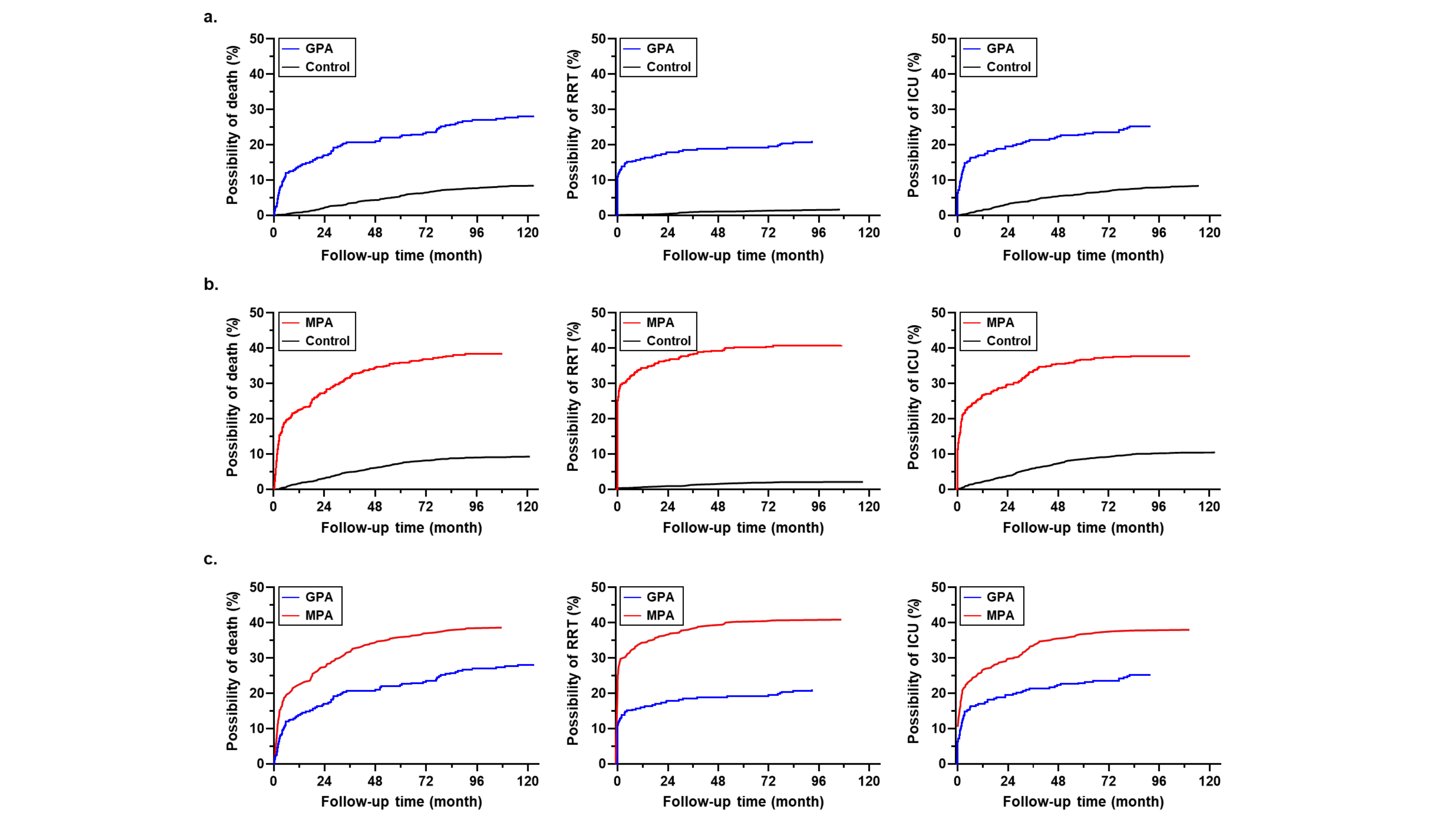
During the observation period, 90 (28.3%) and 187 (38.6%) patients in the GPA and MPA groups, respectively, died. Although all-cause mortality rates in the GPA and MPA group were significantly higher compared to that in each comparator group (adjusted HR 5.15 [3.21 to 8.38] and 8.62 [6.52 to 11.4], respectively), it was even higher in patients with MPA (adjusted HR 1.69 [1.31 to 2.18]). Patients in the GPA and MPA groups also showed a significantly higher risk of renal replacement therapy and ICU admission than those in the comparator population. In both groups, mortality and morbidity outcomes occurred mainly within the first year from the diagnosis of underlying vasculitis (Figure 2).
Conclusion: In South Korea, the incidence of MPA has increased over time. Although both GPA and MPA had high rates of mortality and morbidity, MPA has a poorer prognosis than GPA.
Annual incidence (A) and prevalence (B) rates (per million) of GPA and MPA over time.
Kaplan-Meier curves indicating cumulative incidence of all-cause mortality, renal replacement therapy (RRT), and admission to intensive care unit (ICU) compared to the comparator group in patients with GPA (A) and MPA (B). Direct comparison of the incidence of these outcomes showed that all-cause mortality, RRT, and ICU care were more common in patients with MPA (C).
J. Jung: None; J. Park: None; S. Jihun: None; S. Choi: None; S. Park: None; S. Park: None; E. Lee: None.