Shady Younis, Audrey Bai, heidi Wong, Zelda Love, Qian Wang and William Robinson, Stanford School of Medicine, Stanford, CA
Background/Purpose: Mast cells in the osteoarthritis (OA) synovium correlate with disease severity. This study aimed to further elucidate the role of mast cells in OA by RNA-Seq analysis and pharmacological blockade of the activity of histamine, a key mast cell mediator, in murine OA.
Methods: WeexaminedOA synovial tissues and fluids by flow cytometry, immunostaining, single-cell and bulk RNA-Seq, qPCR, and ELISA.Cetirizine,a histamine H1 receptor (H1R) antagonist, was used to treat the destabilization of the medial meniscus (DMM) mouse model of OA.
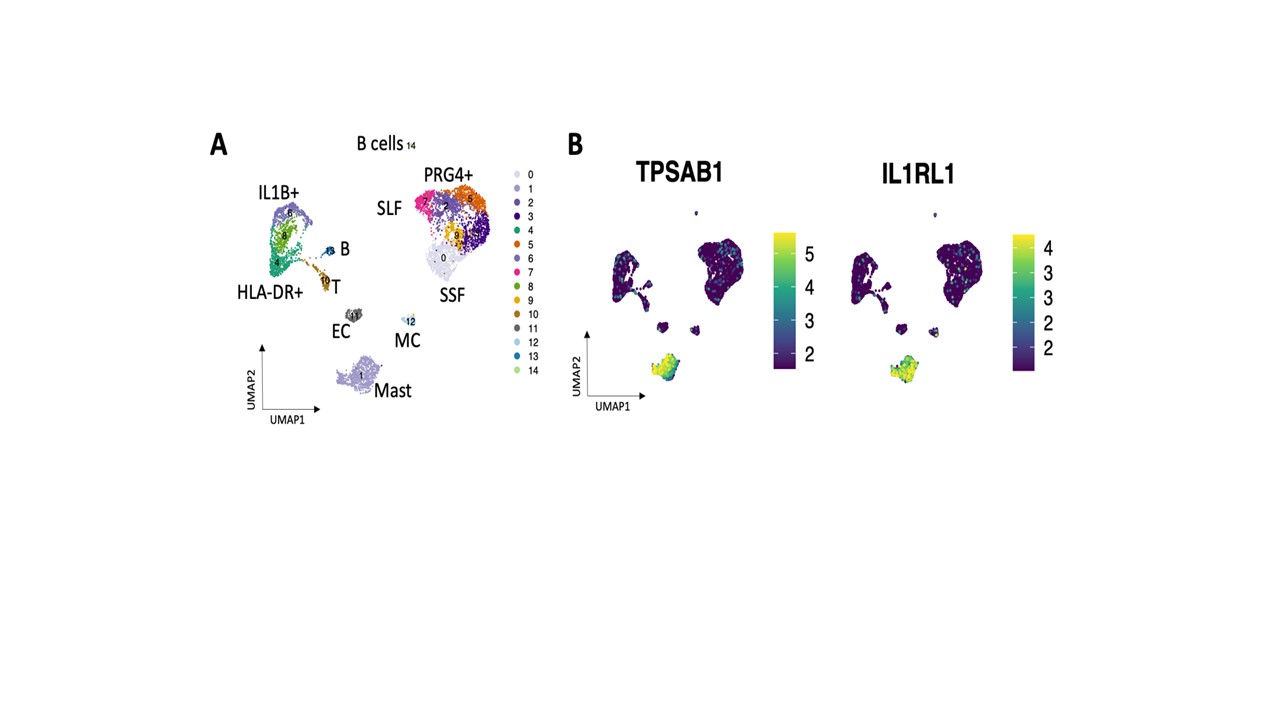
Results: Flow cytometry and immunohistology analysis of OA synovial cells detected the frequencies of KIT+ FcεRI+ and TPSAB1+ mast cells. Single-cell RNA-Seq of OA synovial cells identified the expression of prototypical mast cell markers KIT, TPSAB1, CPA3 and HDC, as well as distinctive markers HPGD, CAVIN2,IL1RL1, PRG2, and CKLF, confirmed by bulk RNA-Seq and qPCR.A mast cell prototypical marker expression score classified 40 OA patients into three synovial pathotypes: mast cell-high, -medium, and -low. Additionally, we detected mast cell mediators including histamine, tryptase AB1, CPA3, PRG2, CAVIN2, and CKLF in OA synovial fluids. Elevated H1R expression was detected in human OA synovium, and treatment of mice with the H1 receptor antagonist cetirizine reduced the severity and OA-related mediators in DMM.
Conclusion: Based on differential expression of prototypical and distinct mast cell markers, human OA joints can be stratified into mast cell-high, -medium, and -low synovial tissue pathotypes. We further show that pharmacologic blockade of histamine activity reduces development of OA in mice, suggesting that targeting of the mast cell mediator histamine has the potential to provide benefit in subsets of OA in which mast cells contribute to pathogenesis.
Single cell RN-seq of OA synovial tissues. (A) Detection of major cell types present in OA synovial tissues including mast cells, synovial lining fibroblasts (SLF), synovial sub-lining fibroblasts (SSF), endothelial cells (EC) , muscle cells (MC), T B cells. (B) Mast cells expressing high level of TPSAB1 and IL1RL1 genes.
S. Younis: None; A. Bai: None; h. Wong: None; Z. Love: None; Q. Wang: None; W. Robinson: None.