Session: (1124–1154) Miscellaneous Rheumatic & Inflammatory Diseases Poster II
1152: Relation Between Positive MPO-ANCA Antibodies And: Associated Diseases, Anca-associated Vasculitis Specificty, Severity and Prognosis. Study from a Single University Hospital
Fabricio Benavides1, Monica Renuncio-García1, Salma Al Fazazi2, clara escagedo Cagigas1, maria rodriguez Vidriales1, Vanesa Calvo Río3, Juan Irure-Ventura1, luis martin penagos4, Marcos Lopez-Hoyos5 and Ricardo Blanco6, 1Hospital Universitario Marqués de Valdecilla, Santander, Spain, 2Hospital Universitario Puerta Del Mar, Cádiz, Spain, 3Valdecilla Hospital, Santander, Spain, 4Division of Nephrology, Immunopathology Group, Hospital Universitario Marqués de Valdecilla-DIVAL, Santander, Spain, 5Marques de Valdecilla University Hospital-IDIVAL, Santander, Spain, 6Hospital Universitario Marqués de Valdecilla, IDIVAL, Santander, Spain
Background/Purpose: ANCA-associated vasculitis (AAV) is a group of pathologies characterized by necrotizing inflammation that mainly affects small and medium-sized vessels. Serum anti-neutrophil cytoplasmic antibodies (ANCA), mainly anti-myeloperoxidase (anti-MPO) and anti-proteinase 3, levels may correlate to severity and prognosis of the disease. Our objective was to identify the diseases associated with positive anti-MPO antibodies detected in a single university hospital and attempt to establish whether there is a cut-off point that correlates anti-MPO antibody levels with disease severity and prognosis.
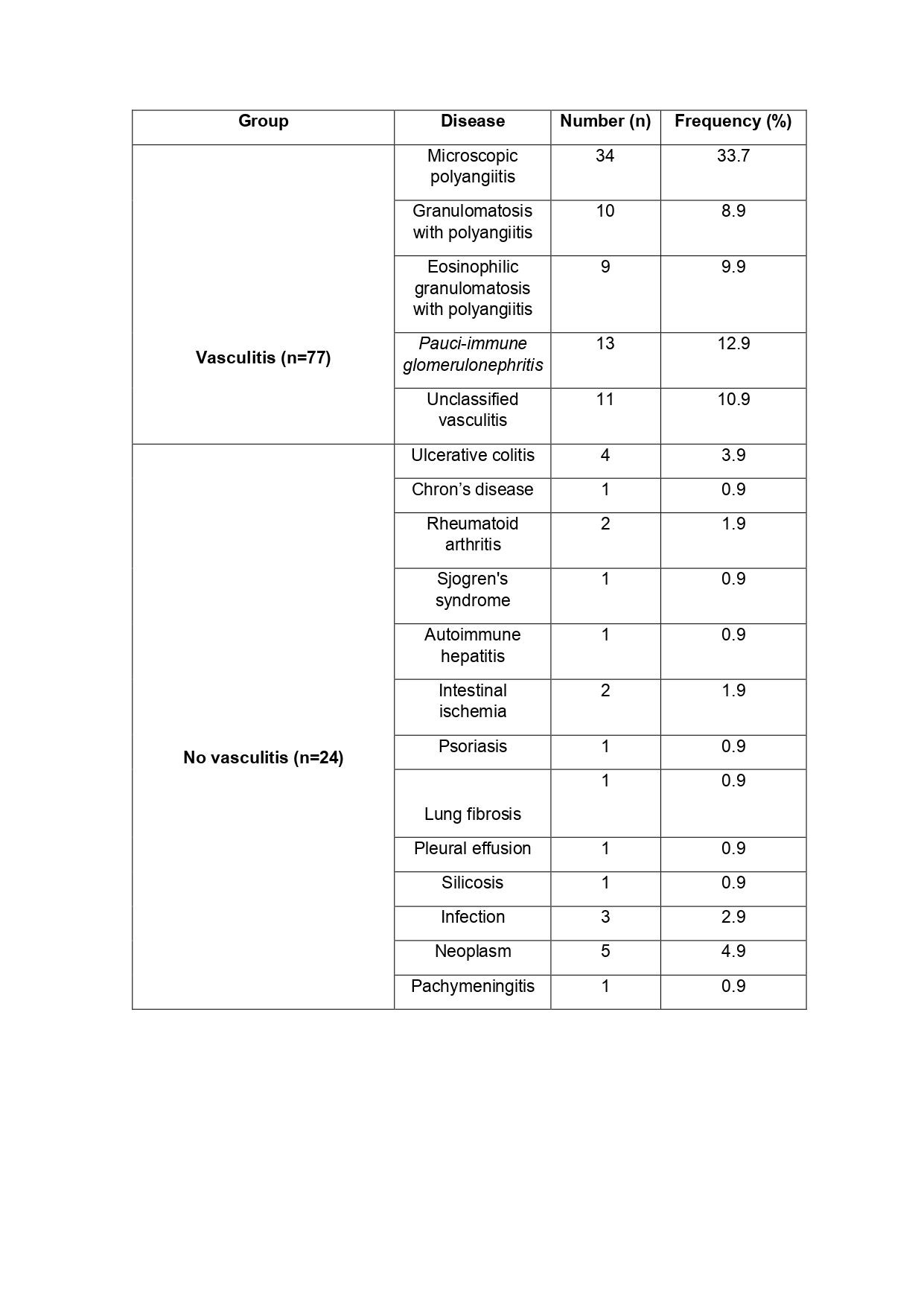
Methods: Table 1 summarizes the frequency of positive anti-MPO antibodies, using laboratory established cut-off value, in different diseases based on a retrospective investigation of 101 positive anti-MPO antibody patients. Then, anti-MPO specificity to vasculitis was evaluated. Furthermore, data of renal disease (hematuria and/or proteinuria) and pulmonary involvement (hemoptysis, asthma and/or respiratory insufficiency) were collected at vasculitis diagnosis, as well as whether the illness progressed to the stage of requiring dialysis, transplantation, or mortality.
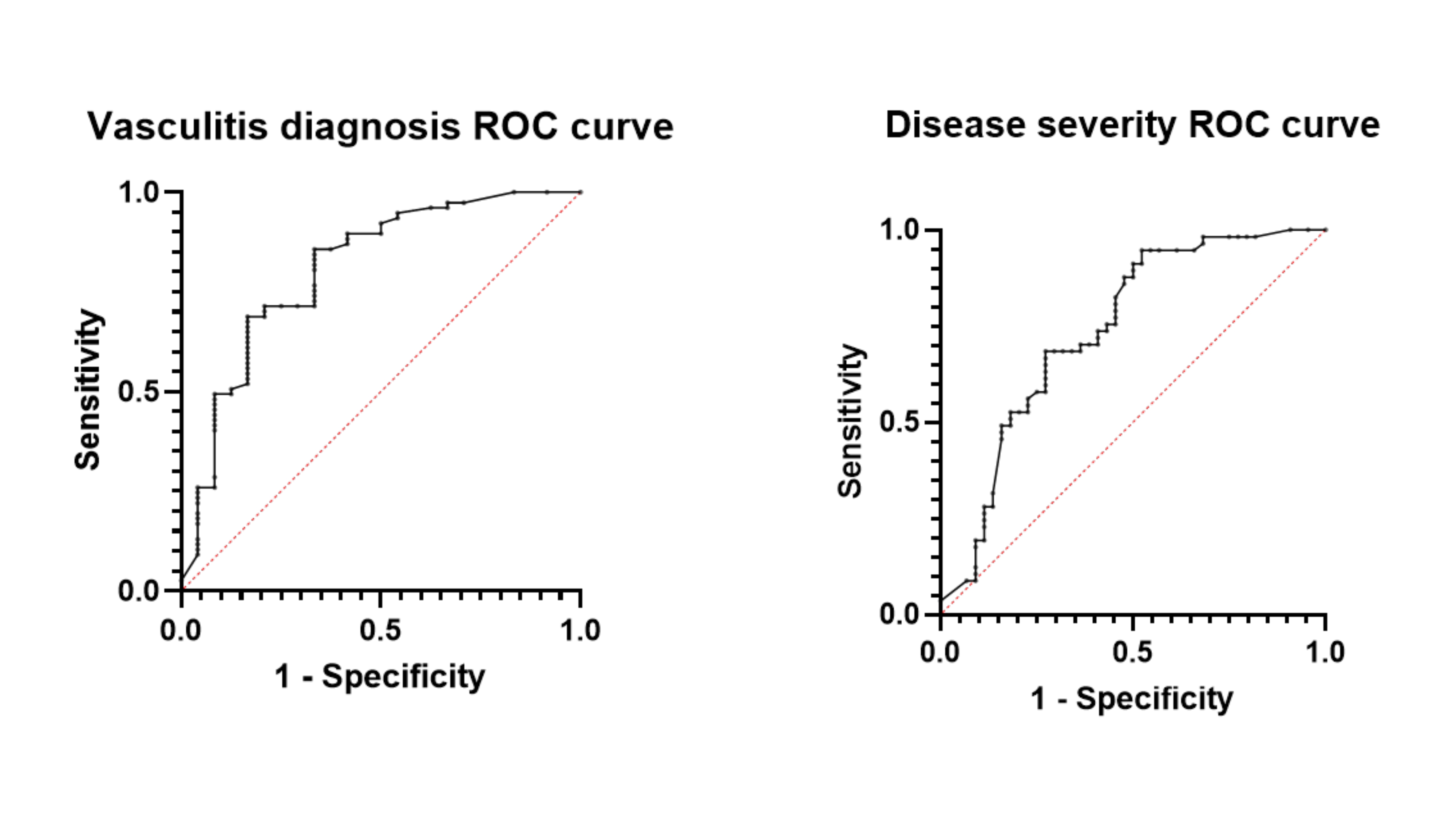
Results: For anti-MPO antibodies with a diagnosis of vasculitis (n=77), an area under the curve (AUC) was calculated (AUC=0.8084), and a cut-off point of 41.5 IU/ml was determined (Figure 1). When the analysis was restricted to exclusively microscopic polyangiitis diagnoses (n=34), the cut-off point was 36.5 IU/ml with an AUC of 0.6435. There were significant differences in anti-MPO levels between patients with renal or pulmonary dysfunction (n=65) versus those without them (n=36) (p=0.0003), and a cut-off threshold of 60 IU/ml was established. Finally, after evaluating the illness's prognosis, an AUC= 0.5546 was found, being no significant differences between those patients who had a worse disease progression (n=19) and those who did not (n=82) (p=0.4643).
Conclusion: Anti-MPO levels at the moment of vasculitis diagnosis are related with disease severity but not with disease outcome.
TABLE 1. Diseases associated with positive anti-MPO antibodies (n=101).
FIGURE 1. Receiver Operating Characteristic (ROC) plots for AAV and positive MPO-antibodies (AUC=0.8084) and disease severity at diagnosis (AUC=0.7160).
F. Benavides: None; M. Renuncio-García: None; S. Al Fazazi: None; c. escagedo Cagigas: None; m. rodriguez Vidriales: None; V. Calvo Río: None; J. Irure-Ventura: None; l. martin penagos: None; M. Lopez-Hoyos: None; R. Blanco: AbbVie, 5, 6, Amgen, 6, AstraZeneca, 2, BMS, 6, Eli Lilly, 6, Galapagos, 2, 6, Janssen, 2, 6, MSD, 6, Novartis, 2, 6, Pfizer, 2, 6, Roche, 5, 6, Sanofi, 6.