Session: (1264–1307) RA – Diagnosis, Manifestations, and Outcomes Poster II
1284: Baseline Data's Role in Predicting All-cause Mortality in Chinese Rheumatoid Arthritis Patients: Findings from the China Registry of Rheumatoid Arthritis (CREDIT) Study
Peking Union Medical College Hospital, Chinese Academy of Medical Sciences & Peking Union Medical College Beijing, China
Disclosure information not submitted.
Kangping Huang1, Mucong Li1, Chen Yu1, Nan Jiang1, Jiuliang zhao1, Qian Wang1, Peng Yin2, Xinping Tian1, Mengtao Li1 and Xiaofeng Zeng1, 1Peking Union Medical College Hospital, Chinese Academy of Medical Sciences & Peking Union Medical College, Beijing, China, 2Chinese Center for Disease Control and Prevention, Beijing, China
Background/Purpose: Rheumatoid arthritis (RA) poses significant challenges for patients in China due to prolonged disease duration prior to a definitive diagnosis, resulting in comorbidities and increased mortality rates in RA management. Although the ACR/EULAR guideline has identified certain laboratory results as poor prognostic factors (PPFs), their availability is limited in community-based centers, particularly in rural areas. Moreover, comprehensive patient follow-up remains a challenge. Consequently, the utilization of readily accessible baseline data assumes paramount importance in the nationwide management of RA. This study seeks to predict mortality rates by leveraging baseline data obtained from a nationwide cohort of RA patients.
Methods: The clinical data utilized in this study were obtained from the database of the Chinese Registry of Rheumatoid Arthritis (CREDIT), while the survival outcome data were from the Chinese Center for Disease Control and Prevention. The datasets were linked based on the diagnosis ID, and the baseline data were extracted based on the first recorded follow-up date. Data cleaning was performed to ensure data quality. To identify the most crucial features, the least absolute shrinkage and selection operator (LASSO) technique was employed. Subsequently, two modeling approaches, the Cox proportional hazards model (Cox model) and random survival forest (RSF), were simultaneously applied to develop predictive models using the selected features. The performance of these models was evaluated by Harrell's concordance index (C-index) and compared.
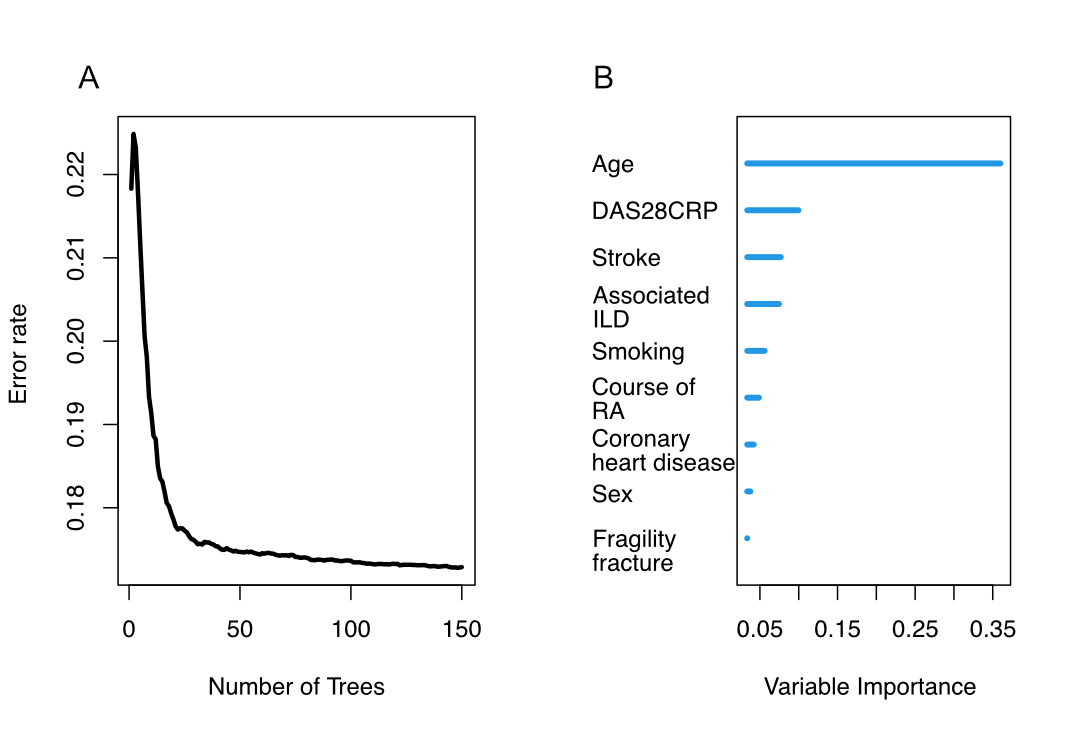
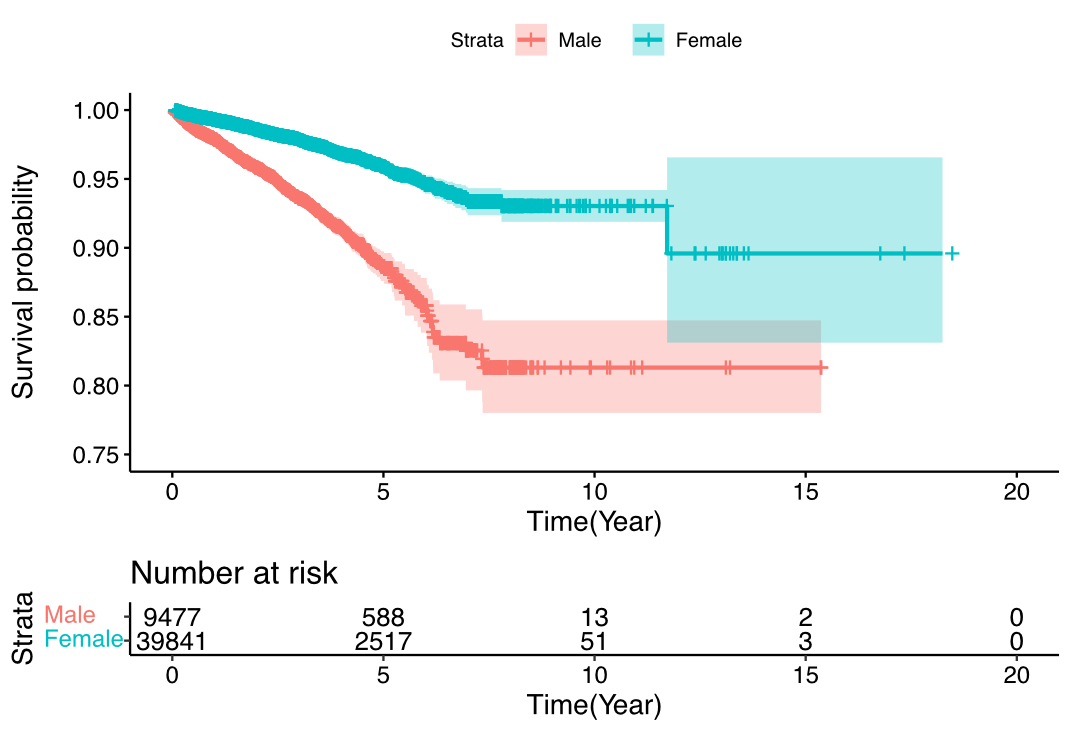
Results: The registry was initiated on October 9, 2003, and is currently ongoing. Survival outcomes were collected until December 31, 2021, with no loss to follow-up observed. A total of 49,318 patients (Mean age: 51.96 (IQR: 44.00-61.00); Female sex: 39.841, 80.78%) diagnosed with RA from 125 medical centers across China were included in this study. 1,648 deaths were recorded, while 47,670 patients remained under observation (Figure 1). The LASSO technique identified 9 variables within 1 standard error, which were utilized in model construction. Notably, the variables demonstrating significant importance were sex, smoking status, stroke, and the presence of associated interstitial lung disease (ILD), as evidenced by the beta coefficients in the Cox model and the Variable Importance (VIMP) in the RSF model (Figure 2 and 3). The Cox model exhibited a C-index of 0.831 (95% confidence interval [CI]: 0.808-0.852), while the RSF model achieved a C-index of 0.879 (95% CI: 0.829-0.916).
Conclusion: This study shows that the risk of mortality in RA patients can be predicted based on demographic factors and comorbidities from baseline data. Specifically, male sex, smoking, stroke, and the presence of associated ILD were identified as factors associated with a higher risk of mortality. Both the Cox model and RSF proved to be effective methods for mortality prediction while the RSF model exhibited higher accuracy but lower explainability. Future research could focus on exploring the prediction of comorbidities within the same cohort, further enriching our understanding of their impact on mortality risk in RA patients.
Figure 1. Kaplan-Meier analysis of sex factor. Shades of the curves shows 95% confidential intervals.
Figure 2. Variable selection using the least absolute shrinkage and selection operator (LASSO) model and results from Cox model. (A) LASSO model coefficient profiles of the 33 candidate variables. (B) Cross-validation in the LASSO model. The error bars represent the partial likelihood deviance standard error (SE). (C) Forest plot of hazard ratio according to Cox model.
Figure 3. Random survival forest (RSF) model. (A) Out-of-bag (OOB) error rate to number of trees. (B) Bar plot of variable importance (VIMP).
K. Huang: None; M. Li: None; C. Yu: None; N. Jiang: None; J. zhao: None; Q. Wang: None; P. Yin: None; X. Tian: None; M. Li: None; X. Zeng: None.