GEORGE WASHINGTON UNIVERSITY Washington, DC, United States
Disclosure information not submitted.
Aileen Chang1, Samuel Simmens1, Hugh Watson2, Richard Amdur3, Andre Siqueira4, Abigale Proctor1, Sarah Tritsch1, Carlos Herrera1, Liliana Encinales5, Alfonso Sucerquia1, Alejandro Jaller1, Juan Jose Jaller6, Kennedy Amaral7, Gary Simon1, Larry Moreland8, Andres Cadena9 and Gary Firestein10, 1George Washington University, Washington, DC, 2Evotec, Lyon, France, 3Northwell, Washington, DC, 4Fiocruz, Rio, Brazil, 5Allied Research Society, Barranquilla, Colombia, 6Reumatologos SAS, Barranquilla, Colombia, 7Institute of Diagnostic Medicine of Cariri, Pernambuco, Brazil, 8University of Colorado, Denver, CO, 9Clinica de la Costa, Barranquilla, Colombia, 10University of California San Diego, San Diego, CA
Background/Purpose: Chikungunya virus is an alphavirus spread by mosquitos that causes a debilitating chronic arthritis that has no standard treatment to date. The objective of this expert group was to develop a measure of chikungunya arthritis that would be useful for clinical trials and patient care.
Methods: A group of chikungunya experts, rheumatologists and biostatisticians identified component measures for evaluation for inclusion in a chikungunya arthritis disease activity score (CHIK-DAS). Utilizing data from a Colombian cohort of chikungunya arthritis patients (N=84), linear regression was used to identify the components that were independently associated with patient reported outcomes assessing disability, pain, physical and mental quality of life and mobility. A preliminary instrument was developed and assessed for internal consistency and test-retest reliability. Cutoffs for grading disease severity were determined.
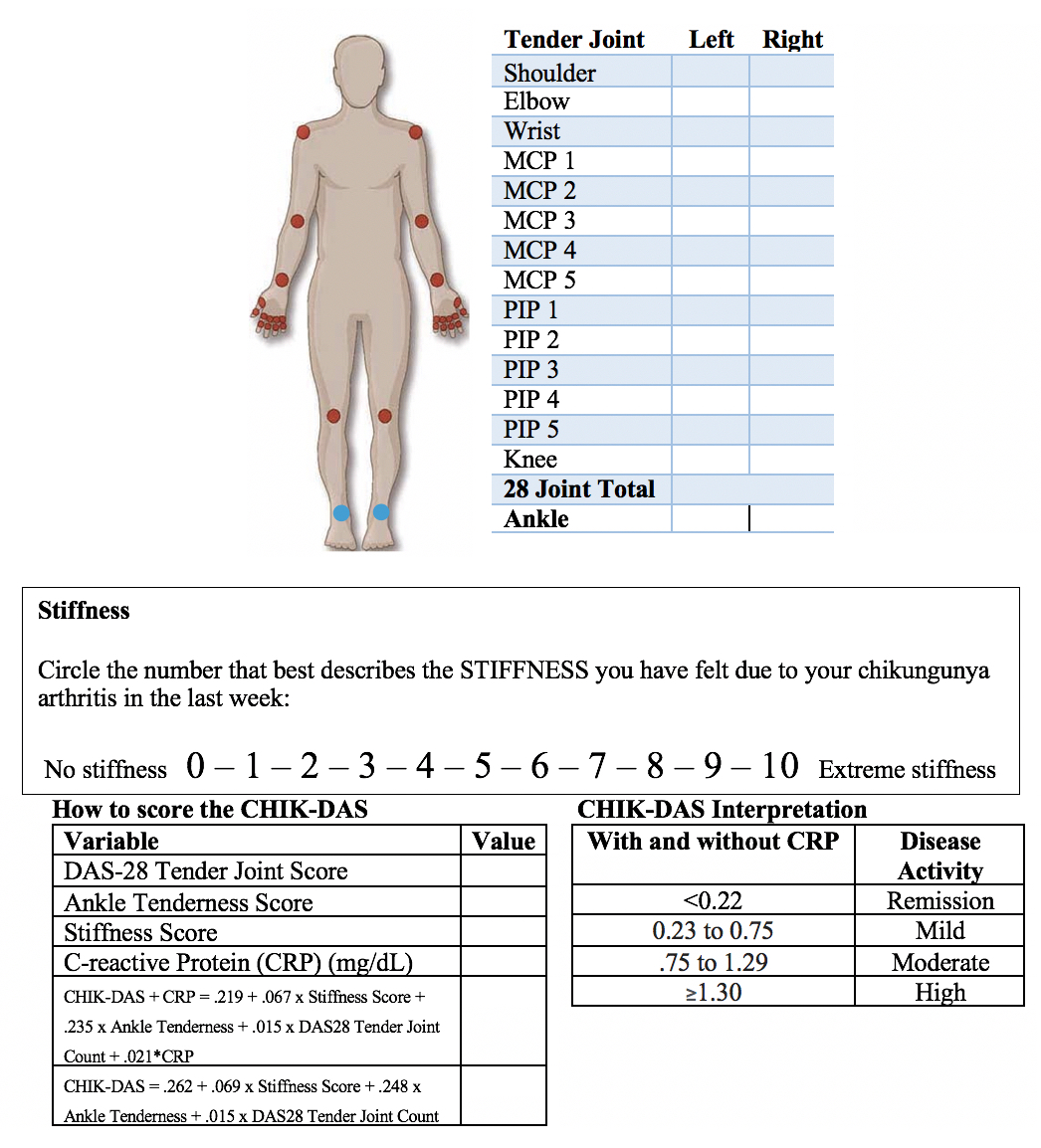
Results: A CHIK-DAS was developed including a 30 tender joint count and a stiffness item in a form with and without CRP. Disease activity was defined as remission (< 0.22), mild (< 0.75), moderate (0.75-1.29) and severe (≥1.30) disease.
Conclusion: The CHIK-DAS may be used as a specific measure of disease activity in chikungunya arthritis in clinical trials and patient care. This metric should be further validated in additional cohorts.
Chikungunya Disease Activity Score (CHIK-DAS). The items 30 tender joint count including the 28 joints from the DAS-28 and the ankle joints and a stiffness score with and without C-reactive protein. The 28 joints included in the DAS-28 are the bilateral shoulders, elbows, wrists, metacarpophalangeal, proximal interphalangeal and knees.
A. Chang: None; S. Simmens: None; H. Watson: Evotec, 3; R. Amdur: None; A. Siqueira: None; A. Proctor: None; S. Tritsch: None; C. Herrera: None; L. Encinales: None; A. Sucerquia: None; A. Jaller: None; J. Jaller: None; K. Amaral: None; G. Simon: None; L. Moreland: Boehringer-Ingelheim, 12, member of independent Data Safety Monitoring Board, Celltrion, 12, member of independent Data Safety Monitoring Board; A. Cadena: None; G. Firestein: Eli Lilly, 5.