GEORGE WASHINGTON UNIVERSITY Washington, DC, United States
Disclosure information not submitted.
Aileen Chang1, Sarah Tritsch1, Carlos Herrera1, Liliana Encinales2, Andres Cadena3, Wendy Rosales4, Evelyn Mendoza5, Samuel Simmens1, Richard Amdur6, Paige Fierbaugh1, Abigale Proctor1, Alfonso Sucerquia1, Christopher Mores1, David Boyle7, Gary Firestein7 and Gary Simon1, 1George Washington University, Washington, DC, 2Allied Research Society, Barranquilla, Colombia, 3Clinica de la Costa, Barranquilla, Colombia, 4Universidad Libre, Barranquilla, Colombia, 5Universidad Libre, Bogotá, Colombia, 6Northwell, Washington, DC, 7University of California San Diego, San Diego, CA
Background/Purpose: The objective was to define the relationship between chronic chikungunya (CHIKV) post-viral arthritis disease severity, interleukin (IL)-2, and T cell subsets in order to determine if arthritis therapies targeting enhanced regulatory T cell (Treg) activity such as low-dose IL-2 may provide benefit.
Methods: Participants with CHIKV arthritis were recruited from Colombia from 2019–2021. Arthritis disease severity was quantified using the Disease Activity Score (DAS)-28 and an Arthritis-Flare Questionnaire adapted for CHIKV arthritis. Plasma cytokine concentrations (IL-1β, IL-2, IL-4, IL-6, IL-8, IL-10, IL-12p70, IL-13, interferon-γ and tumor necrosis factor (TNF)) were measured using a Meso Scale Diagnostics assay. Peripheral blood Treg subsets were measured using flow cytometry.
Results: Among participants with CHIKV arthritis (N=158),IL-2 levels and frequency of Tregs were low. Increased arthritis disease activity was associated with higher levels of inflammatory cytokines (IL-6, TNF and CRP) and immunoregulatory cytokine IL-10 without increases in IL-2 (p< 0.05). Increased arthritis flare activity was associated with higher Treg frequencies (p< 0.05) without affecting Teff frequencies, Treg/Teff ratios and Treg subsets. Finally, elevated levels of IL-2 were correlated with increased Treg frequency, percent Tregs out of CD4+ T cells, and Treg subsets expressing immunosuppressive markers, while also correlating with an increased percent Teff out of live lymphocytes (p< 0.05).
Conclusion: CHIKV arthritis is characterized by increased inflammatory cytokines and deficient IL-2 and Treg responses. Greater levels of IL-2 were associated with improved Treg numbers and immunosuppressive markers, suggesting that low-dose IL-2 therapies targeting enhanced Treg activity may be a plausible objective for further investigation.
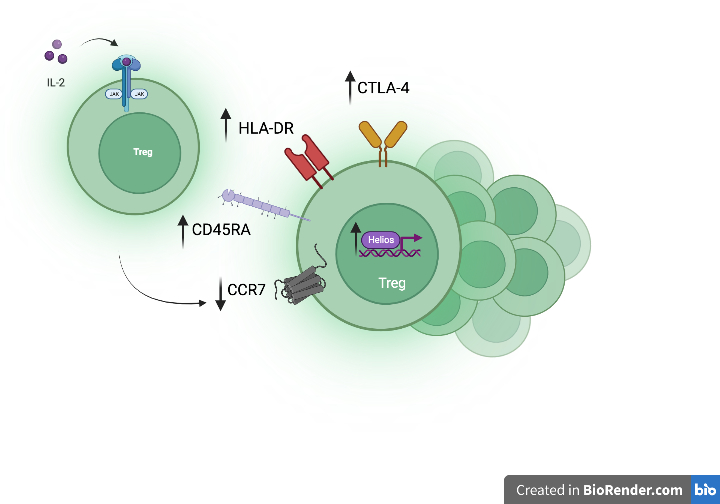
Increasing IL-2 in chikungunya arthritis is associated with increased Treg numbers and expression of immunomodulatory markers. Herein we report that higher levels of IL-2 in chikungunya arthritis patients were associated with greater numbers of Tregs. Greater IL-2 was also associated with enhanced expression of CTLA-4, which suppresses effector T cell activation by decreasing antigen presenting cell costimulatory function (CD80/CD86). Additionally, higher IL-2 levels of IL-2 were associated with higher expression of HLA-DR, which functions in Treg activation; CD45RA, found in resting Tregs; and Helios, a transcription factor that acts on the Foxp3 promotor to increase immunosuppressor function. Last, increased IL-2 levels correlated with decreased CCR7, whose deficiency permits Treg retention in inflamed tissue.
A. Chang: None; S. Tritsch: None; C. Herrera: None; L. Encinales: None; A. Cadena: None; W. Rosales: None; E. Mendoza: None; S. Simmens: None; R. Amdur: None; P. Fierbaugh: None; A. Proctor: None; A. Sucerquia: None; C. Mores: None; D. Boyle: None; G. Firestein: Eli Lilly, 5; G. Simon: None.